



In 2004, American healthcare employed roughly one administrator for every two physicians.
Today, it’s nearly three for every four.¹
Nobody in a hospital boardroom is asking whether that trade made care any better. I am.
I have spent my entire career inside hospitals. Trained at Mayo Clinic. Two decades in operating rooms. More than 10,000 joint replacements.
I know exactly what it takes to move a patient from the pre-op bay to the recovery room. And I’ve watched the building fill up with people who never touch that process.
I call it administrative creep
It never arrives in one dramatic decision. No board has ever voted to bury its surgeons in bureaucracy.
It happens one role at a time. One committee. One reporting layer.
Compliance. Quality reporting. Revenue cycle. Population health. Then managers to coordinate the managers.
Each hire sounds reasonable on its own. Together, they quietly rewire the hospital until a growing share of the organization exists to administer itself.
Let me be clear. Good administrators are essential. I work alongside brilliant ones, and medicine does not run without them.
But essential is not the same as unlimited.
The numbers, read honestly
Stanford School of Medicine researchers Becca Nelson, Margaret Nikolov and Kevin Schulman recently analyzed 20 years of Bureau of Labor Statistics occupational data.¹ From 2004 to 2024:
Healthcare administrators grew from 224,070 to 565,840 (+153%)
Physicians grew from 471,390 to 778,450 (+65%)
The administrator-to-physician ratio rose from 0.48 to 0.73
In raw numbers, the system added more administrators than doctors over those two decades. And the authors found the growth accelerated after the Affordable Care Act, right as reporting requirements, payment-model complexity and consolidation took off.
The cost side is just as stark.
In a 2021 JAMA viewpoint, researchers from Harvard and McKinsey estimated that $265 billion in annual administrative spending could be cut without reducing quality or access.² That’s more than a quarter of everything the system spends on administration.
Not a rounding error. A quarter trillion dollars. Every year.
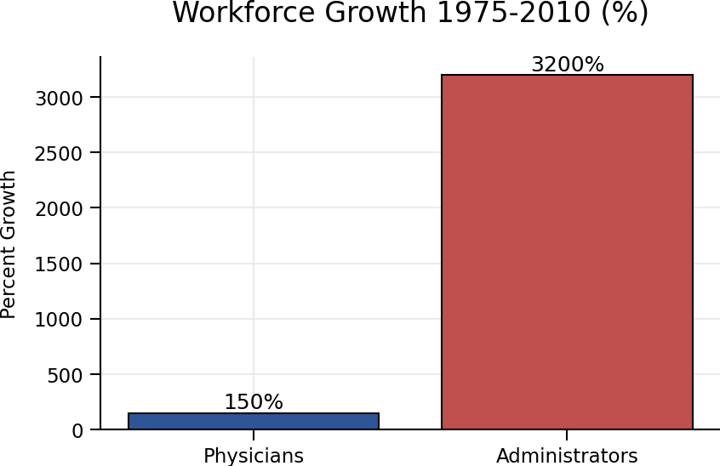
More staff. Less care.
Here’s what this looks like from inside the operating room.
More meetings. More dashboards. More approvals. More people who must sign off before anything changes.
And somehow, less time in front of patients.
The real question isn’t whether administrators are necessary. It’s whether 20 years of administrative growth produced anything a patient can actually feel.
So ask for the receipts. Are OR turnover times faster? Are we doing more cases per room per day? Can patients get in sooner? Are nurses staying? Are surgeons more productive? Are outcomes better? Are margins healthier?
If an organization grew its administrative layer by 150% and can’t show movement on those metrics, that isn’t infrastructure.
That’s overhead dressed up as progress.

I’ve made this mistake too
I’m not throwing stones from outside the building. I run a $40 million organization with 100 employees. I sign the offer letters.
When we were scaling Indiana Orthopedic Institute fast, I fell into the same reflex every growing organization does. A problem surfaced, it felt urgent, and the instinct was to hire someone to own it. The role became the solution before anyone defined what “solved” looked like.
Some of those hires were outstanding. Some generated more meetings than results.
The lesson was expensive: a new layer is not a fix. It’s a hypothesis. And almost no organization ever tests it.

The difference at IOI is structural. We grew from two people to 100 employees and 16 surgeons in roughly three years, and the people delivering care own the organization. Surgeons don’t get told how care is organized after the fact. We decide it, and we live with the results.
That’s not a slogan. It’s a feedback loop most hospital systems have engineered out.
The Earned Layer Framework
Every administrative role should earn its place the way an incision does: a clear purpose, a defined endpoint, a measurable result.
Tie every role to a front-line metric. If a position can’t move OR efficiency, access, retention, outcomes or margin, ask why it exists.
Subtract before you add. No new layer gets approved unless it removes a burden from the front line, not just adds a report to it.
Put a sunset on it. Review every non-clinical role at 12 months against the metric it was hired to move. Renew it or retire it.
Put clinicians in the room. The people delivering care help decide how it’s organized. They are not informed afterward.
To the surgeons reading this
The hospital will not audit its own overhead. The incentives run the other way: complexity creates roles, roles create budgets, and budgets create more complexity.
So do it yourself.
Ask your leadership for your institution’s administrator-to-physician ratio and how it changed over five years. Ask which metrics those hires were meant to move. Ask to see the results.
If nobody can answer, you have your answer.
And if you lead a hospital: you don’t need fewer good administrators. You need every one of them pointed at the patient.
Hospitals don’t get better by getting bigger at the top. They get better when every layer earns its place.
What does administrative growth look like where you work? Is it improving care, or just adding complexity?
Notes
Nelson B, Nikolov MC, Schulman K. “The Growth in Healthcare Administrators since 2004 in the United States.” Health Management, Policy and Innovation, 2026. Analysis of BLS Occupational Employment and Wage Statistics data.
Sahni NR, Carrus B, Cutler DM. “Administrative Simplification and the Potential for Saving a Quarter-Trillion Dollars in Health Care.” JAMA. 2021;326(17):1677-1678.
Cantlupe J. “The rise (and rise) of the healthcare administrator.” athenaInsight, November 2017.
Drum K. “Join Me On a Dive Down the Rabbit Hole of Health Care Admin Costs.” Mother Jones.
