


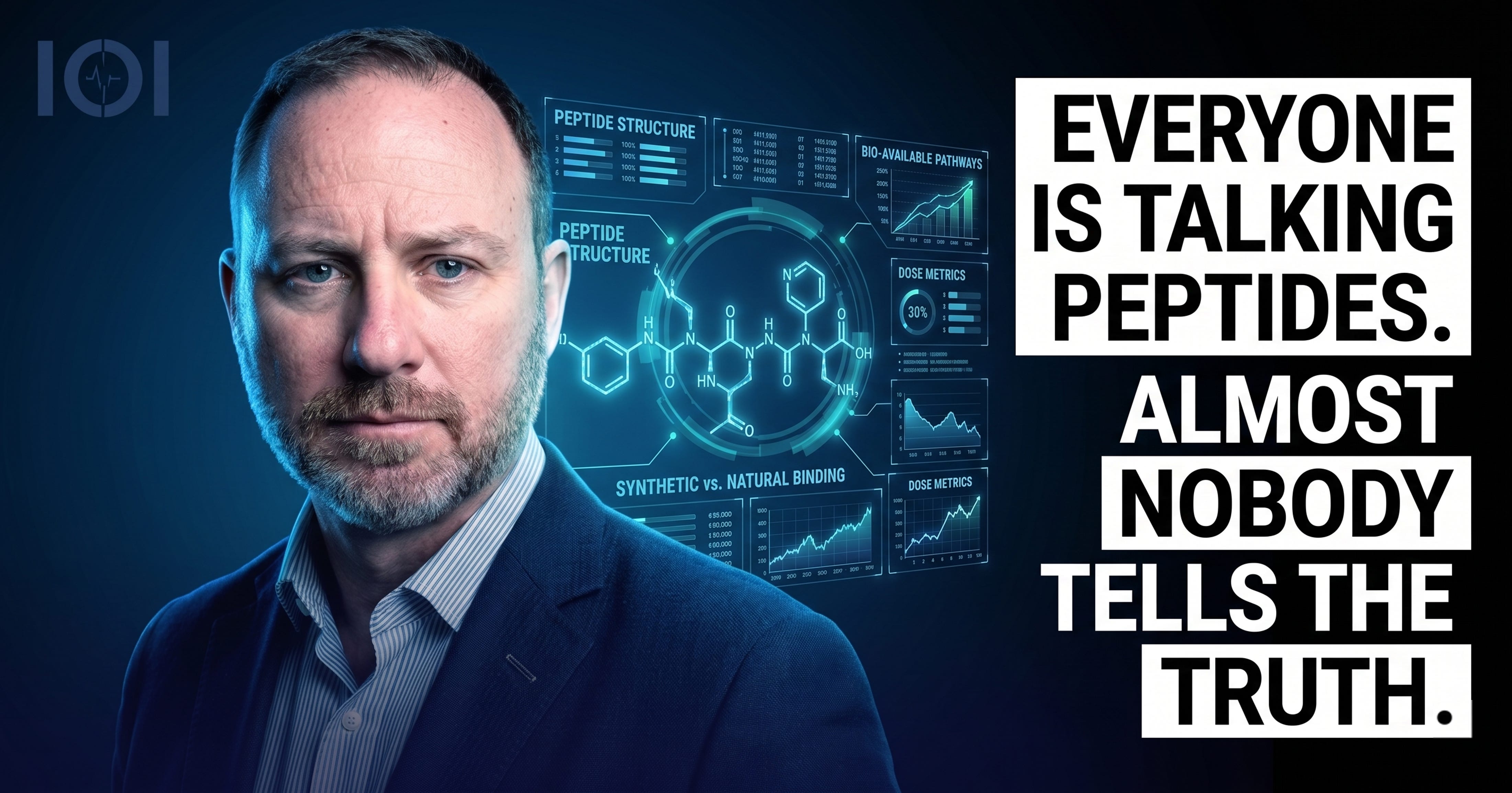
A patient of mine came in last fall, not for a consultation about his hip, but to ask me about peptides. He’d been injecting BPC-157 he ordered online for three months. No prescription. No oversight. No idea what he was actually putting in his body.
He wasn’t reckless. He was desperate. Chronic tendon pain, slow recovery, a body that wasn’t doing what it used to. He’d read the forums, watched the videos, and decided to act. I respected that instinct, even as I sat across from him calculating the risk he’d taken.
That conversation is happening everywhere right now. In clinics. In gyms. In group chats between people who are tired of feeling like their doctors have no answers. And most of the time, nobody is giving a straight answer.
I will.
The Biology Is Real. The Market Is Chaos.
Let me be clear about something first: peptides are not fringe science.
Insulin is a peptide. You know insulin. Semaglutide, the active compound in Ozempic and Wegovy, is a peptide. It just reshaped the global conversation about obesity. The FDA’s approval of the first oral semaglutide tablet for chronic weight management in late 2025 didn’t happen because molecules like this are unproven novelties. It happened because peptide biology, at the right end of the research spectrum, is some of the most precise and powerful pharmacology we have.
A peptide is a chain of amino acids, shorter than a protein, which makes it more targeted in function. These molecules act as biological messengers, instructing specific cells to perform specific tasks. Your body already produces thousands of them. The therapy argument is simple: can we supplement with synthetic versions to restore processes that slow with age or stress?
In some cases, yes. In many cases, we do not yet know. And that gap is where everything goes wrong.
Where the Science Ends and the Hype Begins
Here is the distinction that most of the wellness industry refuses to make clearly, so I will make it for you.
There are FDA-approved peptides with rigorous human trial data, clear mechanisms, and established safety profiles. Then there is a much larger category of peptides that are biologically plausible, show promising results in animal models, and are being injected by thousands of people with zero physician involvement, based on forum posts and influencer content.
Online peptide advertising increased 678% between 2022 and 2025 as GLP-1 drugs gave the entire category mainstream credibility by association.¹ If semaglutide, a peptide, could do what Ozempic does, the logic went, what else might these molecules be capable of? That halo effect drove enormous interest straight into the gray market, and straight into people’s bodies.
BPC-157 is the most visible example of what that looks like when it goes wrong. It is arguably the most popular peptide in the biohacking world. People are injecting it for tendon repair, gut health, and injury recovery. As of early 2026, **35 of 36 published BPC-157 studies are animal-only, sourced from a single lab with undisclosed conflicts of interest.**² The enthusiasm for this compound ran years ahead of the evidence. That is not a minor detail. That is the entire story.
The delivery problem compounds this. Most peptides break down in the digestive tract. Serious use cases require injection, which means sourcing, sterility, accurate dosing, and proper technique all become critical variables. When people are ordering compounds from gray-market vendors with no clinical oversight, every one of those variables is out of control.
The gap between “makes sense in theory” and “proven safe in humans” is vast. I have spent my career on the side of that gap that requires evidence before action. I am not moving.

The Regulatory Reckoning Was Inevitable
The FDA’s posture toward compounded peptides shifted hard in late 2023, and by 2025 it had become a full enforcement campaign. More than 50 warning letters issued to compounders, online sellers, and clinics. Criminal prosecutions. Raids on major gray-market vendors.
The DOJ forced Tailor Made Compounding LLC to forfeit $1.79 million, establishing that the federal government was willing to bring criminal charges, not just civil penalties.³ Peptide Sciences, one of the largest gray-market players, voluntarily shut down in March 2026 before the walls closed in.
The political dimension added one more layer. RFK Jr. publicly pushed the FDA to widen access, calling himself a fan of peptide treatments and signaling that roughly 14 peptides should be made more accessible through compounding pharmacies. The enforcement machine didn’t pause.
But what the political conversation did do, and this matters for everyone following this space, is force a legitimate question onto the table: should patients have a supervised, physician-guided pathway to promising compounds that sit outside the current approval framework?
That is a reasonable question. It deserves a serious answer. Not a gray market, and not a blanket ban.
The crackdown was necessary. Not because the underlying biology is fraudulent. But because access without oversight is not freedom. It is exposure.
What I Actually Believe
I am not here to bury peptides. I am here to be precise about them, because precision is what this conversation has been missing.
The legitimate end of this science is advancing fast. AI-assisted peptide design accelerated discovery pipelines dramatically in 2025. Cancer therapies, metabolic interventions, immune modulation, these are real frontiers with real rigor behind them. The biology deserves serious investment and serious research. And patients deserve physicians who are engaged with it, not dismissive of it.
Here is the framework I use for any emerging intervention, whether it is a peptide, a surgical technology, or a wellness protocol. It applies whether you are a clinician evaluating options or a patient trying to make a smart decision about your own body:
What is the evidence hierarchy? Human trials, animal models, and in-vitro data are not equivalent. Know which one you are standing on before you act.
Who is prescribing and who is sourcing? A compounding pharmacy with a physician-supervised protocol is not the same as a gray-market vendor and a self-injection tutorial.
What is the risk-benefit calculation for this specific person? Not the population. Not the forum. You, your biology, your context.
What is the baseline? No peptide, drug, or technology outperforms a life built on sleep, whole food nutrition, consistent movement, and stress management. That is not a platitude. It is the highest-leverage intervention available to every human being on this planet, and it costs nothing.

The Foundation Always Comes First
I have performed over 10,000 joint replacements. I have watched patients spend years treating symptoms that were the direct consequence of how they lived, how they ate, how much they slept, and how much they moved. And I have watched those same patients expect a molecule to fix what decades of lifestyle built.
It won’t.
The most powerful intervention in human health is still the one that requires the most discipline: prevention. Real food. Real sleep. Real movement. Real relationships. These are not soft suggestions. They are the clinical foundation without which medicine, including the most advanced peptide therapies, is always playing catch-up.
My patient who had been injecting BPC-157 for three months had never had a serious conversation with a physician about his diet, his sleep quality, or his inflammatory load. He went straight to the injection because it felt like action. I understand that impulse completely. People are tired of waiting for the system to give them better options.
But here is what I told him, and what I will say plainly here: action without a foundation is just noise.
If you are curious about peptides, that curiosity is legitimate. The biology is real. The potential is real. But find a physician who will engage with you seriously, demand to know where you are in the evidence hierarchy, and build the lifestyle foundation that makes any intervention actually work.
The shortcut culture that drove the gray market is the same culture that has people spending thousands of dollars on compounds while sleeping five hours a night and eating ultra-processed food.
The molecule is not going to save you from that. Nothing is.
The Bottom Line
We are in an era where the biology of human optimization is genuinely accelerating. The tools are getting more precise. The research is getting more sophisticated. Patients are more informed and more engaged than any generation before them. That is something to build on, not shut down.
The surgeon’s job, and every physician’s job, is to stand at the incision point: where intention meets reality, where the plan meets the patient in front of you. That means demanding evidence, providing real oversight, and being honest when the shortcut isn’t actually shorter.
The molecule is not the enemy. The shortcuts are.
Are you navigating peptide questions as a patient, a clinician, or both? I’d like to hear what you’re seeing, and what answers you’re still looking for.
Footnotes
PeptideExaminer, Online Peptide Market Growth Analysis, 2025.
STAT News / PeptideExaminer, BPC-157 Research Landscape Review, February 2026.
U.S. Department of Justice, United States v. Tailor Made Compounding LLC, 2025.
Transparency from clinicians is what keeps curiosity from turning into harm.
The interesting thing with all of this is how quickly people want a shortcut to the outcome without changing the rest underneath.
That’s why so many conversations around GLP-1s, peptides, and performance end up circling back to the same thing eventually.
The habits still matter. I wrote about that from my own experience too.
🔗 https://millennialmasters.net/p/glp1-discipline