


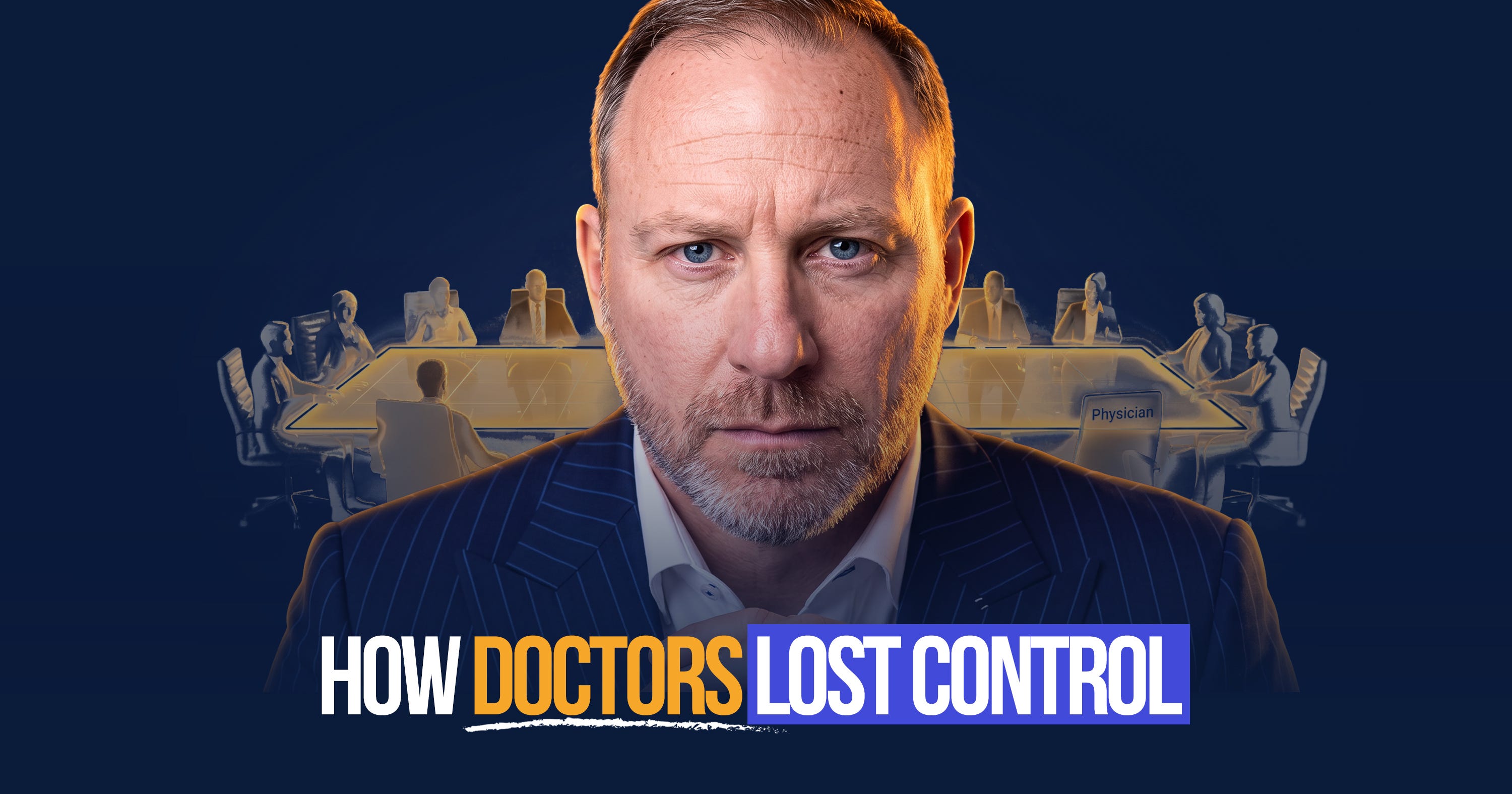
I sat in a boardroom once, surrounded by seven administrators, two CFOs, and a compliance officer. I was the only one who had been in surgery that morning. I was the only one who had touched a patient that week. And yet I was the one being told how care would be delivered.
That moment didn’t happen by accident. It was the result of decades of institutional drift - slow, compounding, and largely self-inflicted.
This is not a complaint. Complaints without blueprints are noise. This is a diagnosis. And like any good diagnosis, it requires honesty about what went wrong before we can discuss how to fix it.
The Machine Didn’t Take Control. We Handed It Over.
Let me be direct: the rise of administrative dominance in American healthcare was not a hostile takeover. It was an abdication.
I have performed over 10,000 joint replacements. I trained at Mayo Clinic. I hold an engineering degree from Rose-Hulman. I have sat on the boards of the largest orthopedic surgeon organizations in the world, and I have built Indiana Orthopedic Institute from two people to over 100 employees, including 16 surgeons, generating $40M in revenue in three years.
I tell you this not to impress you, but because I need you to understand where this perspective comes from. I have been inside the machine. I have watched it operate. And I have seen, up close, exactly how physicians lost the room.
There are six reasons it happened. And five of them are still happening right now.
Reason 1: While We Were Operating, They Were Organizing
Here is the most basic operational reality nobody talks about: administrators have open calendars. Surgeons do not.
While physicians were in the OR - doing the actual work that generates every dollar in the building - administrators were in conference rooms making decisions. Hiring decisions. Policy decisions. Budget decisions. Decisions about how care would be structured, compensated, and evaluated.
We couldn’t attend those meetings. We had patients on the table.
And here is the compounding effect: absence from a meeting is interpreted, in institutional culture, as consent. Show up once to challenge a decision and you are a disruptor. Miss forty meetings and the agenda shapes itself around your absence. Over time, the decisions calcified into policy. The policy became culture. The culture became the system.
This wasn’t malicious in most cases. It was structural. But the outcome was the same: physicians were gradually redesignated from decision-makers to producers. Revenue units with medical licenses.

Reason 2: We Never Learned the Language of Power
Medicine attracts people who love science, not finance. That’s not a weakness - it’s a selection feature. But it became a catastrophic vulnerability.
As a profession, we did not educate ourselves on healthcare economics fast enough. We didn’t learn how hospital systems are financed, how margins are calculated, how contracts are structured, or how capital allocation decisions are actually made. We arrived at the table without the vocabulary to argue, and so we lost the argument before it began.
Administrators spoke the language of operations, finance, and organizational behavior. We spoke the language of clinical outcomes. Both matter. But in the boardroom, financial fluency wins.
The system absorbed that power vacuum and has never released it. Not once in the last thirty years has a major hospital system voluntarily returned decision-making authority to the physicians doing the clinical work. Why would they?
We gave them the keys. They locked the door.
Reason 3: We Never Learned to Negotiate - And Didn’t Know We Should
I want you to sit with this for a moment: the people making multi-million-dollar decisions about physician compensation, contract terms, and care delivery standards are trained negotiators operating against physicians who have received zero formal negotiation training.
Jim Camp. Chris Voss. These names should be in every medical school curriculum. They are not.
Voss’s work - drawn from his career as an FBI hostage negotiator - breaks down how high-stakes communication actually functions: tactical empathy, calibrated questions, the power of “no” as a starting position. Camp’s framework dismantles the idea that compromise is strength. These aren’t soft-skills seminars. They are operational tools for consequential decision-making.
I am not sure most physicians even recognize that they are in a negotiation when they sit across from a hospital administrator. We were trained to believe that doing excellent clinical work was enough… that integrity and quality would be recognized and rewarded.
That is not how institutions work. It is not how power works. And learning that lesson late is expensive.
Reason 4: Leadership Was Never Part of the Curriculum
Here is something that should embarrass the medical education establishment: we spend a decade training physicians in anatomy, pharmacology, procedural technique, and evidence-based medicine… and we spend approximately zero hours teaching them how to lead people, read a balance sheet, or run an organization.
We then watch, confused, as physicians feel uncomfortable in administrative roles and defer to those who do have that training.
This is not complicated. When you are not equipped for a role, you vacate it. Not because you are weak, but because discomfort at the boundary of your competence is a rational signal to retreat.
Administrators filled those leadership vacuums not because they cared more about patients - they often did not - but because they had the skills we lacked. Finance. Organizational behavior. Human resources. Strategic planning.
We built a profession of extraordinarily capable clinicians who were operationally underprepared for the institutions they were embedded in. And then we acted surprised when those institutions were shaped by someone else.

Reason 5: We Are Still Doing It
This is where I stop talking about history and start talking about right now.
Today, in 2026, medical students are still graduating without meaningful training in economics, negotiation, or organizational leadership. Residents are still completing five-year programs without a single structured course in contract law or financial literacy. Fellows are still entering subspecialties where they will generate millions of dollars in revenue annually, without knowing how to read the agreements they are signing.
We are perpetuating the same cycle. Intentionally or not, the institutions that train physicians have made a choice - by omission - to produce clinicians who are dependent on administrative infrastructure and therefore controllable within it.
This is not conspiracy. It is incentive alignment. A physician who understands organizational finance is a more expensive employee. A physician who knows negotiation is harder to manage. A physician who has leadership training might decide to build something outside the system.
That last one - that’s what I did. That’s what Indiana Orthopedic Institute is.
These concepts must be in medical school and residency curricula. Not as electives. Not as optional seminars. As core requirements, alongside anatomy and physiology. Because the system a physician will enter is just as real as the body they will operate on, and just as unforgiving of ignorance.
Reason 6: The Selection Bias Nobody Talks About
This one requires honesty that makes people uncomfortable. But I am a surgeon. Comfortable dishonesty costs lives.
Medicine selects for a specific personality profile. Intelligent. Diligent. High-integrity. Service-oriented. Willing to take the Hippocratic Oath and mean it. These are profound qualities. They are not, however, the qualities that tend to produce effective institutional navigators.
The traits that help someone excel in medical training - deference to authority, precision in following protocols, commitment to doing things correctly - are frequently liabilities in organizational power dynamics. Institutional influence rewards a different set of skills: comfort with ambiguity, tolerance for interpersonal tension, willingness to engage in negotiation and conflict without it destabilizing your identity.
Physicians are not, as a rule, selected or trained for those capacities. And so when organizational conflict arises, which it always does at the intersection of clinical care and financial pressure, physicians self-select out of the confrontation. We retreat to what we are excellent at: patient care. And we leave the room to people who are comfortable being in it.
This is not a character flaw. It is a systems design failure. The personality traits that make someone an exceptional surgeon are genuinely different from those that make someone an effective organizational leader. We have never built a system that accounts for this, trains for it, or compensates for it.
The result: the people most qualified to advocate for patients in institutional settings are the least equipped, by training, temperament, and time, to actually do so.
The Blueprint: What We Build From Here
I recently had a moment of profound self-reflection. By every objective metric, I am at the top of my game - the surgeries, the research, the organization I’ve built. But I sat with a patient recently, a retired teacher in her late 60s who had delayed her knee replacement for three years because she couldn’t navigate the financial complexity of the system around her. Not the clinical complexity. The administrative complexity. She was failed by the system before she ever reached the OR.
That failure is not abstract to me. It is the reason Indiana Orthopedic Institute exists. And it is the reason I write this.
Here is the framework I call The Three Recoveries… what it will take to reclaim physician authority in American healthcare:
Operational Literacy: Every physician must understand the economics of the system they practice in. Not at an MBA level, but at a functional level. What generates margin. How contracts work. What administrators are actually optimizing for.
Negotiation Fluency: Read Chris Voss. Read Jim Camp. Take a negotiation course before you sign your first employment contract. The system is negotiating with you whether you know it or not.
Leadership by Design: Build organizations intentionally. Ambulatory surgery centers, physician-owned practices, and vertically integrated care models are not just business decisions - they are acts of clinical autonomy. The infrastructure of control is the same infrastructure that determines how you treat patients.
What the System Will Not Do for You
The hospital system will not teach you to negotiate with it. The administrative structure will not train you to challenge it. The institutions that profit from your clinical labor will not redesign themselves to share power with you.
This is not cynicism. It is operational reality.
If you are a resident reading this, understand: the contract you are about to sign was written by people who negotiate contracts every day. You will sign it once. That asymmetry is not accidental.
If you are a practicing surgeon reading this, the question is not whether this system is fair. It isn’t. The question is what you are building outside of it.
The physician who understands finance, negotiation, and organizational leadership is not just a better administrator. They are a better advocate for every patient on their panel.
That is not soft sentiment. That is hard truth backed by thirty years of watching the alternative play out.
We didn’t lose the room in one dramatic moment. We walked out of it, procedure by procedure, meeting by meeting, contract by contract.
It’s time to walk back in.
This giving up control is not confined to the medical profession - education (my husband was probably a disruptor in the ed field - the state DOE sent someone to visit with him after he filled out a survey they sent). And Congress giving control to a beauracy is probably the biggest example. Good article
Definitely, control shifts to those who show up.