


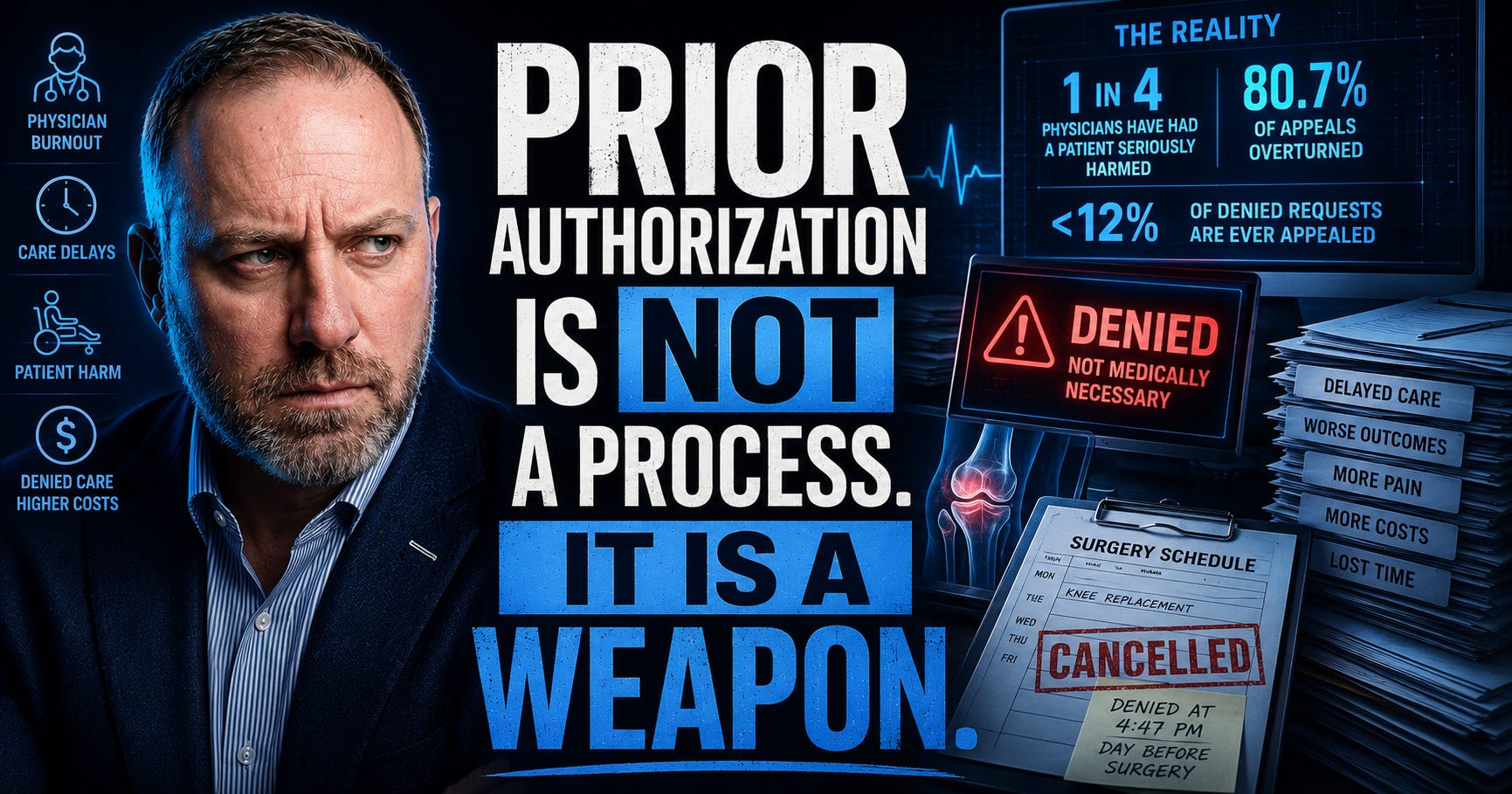
I want to tell you about a specific Thursday.
I had a patient scheduled for a total knee replacement. The surgery had been planned for six weeks. The pre-operative workup was complete. The implants were ordered. My OR team was ready. The patient had taken time off work, arranged for someone to drive them home, and mentally prepared for what they knew would be a difficult but necessary procedure.
The prior authorization was denied at 4:47 PM the day before.
No clinical review. No conversation with me. A determination made by someone who had never examined this patient, never reviewed imaging with a surgeon present, never stood at an operating table in their life, that the surgery was not medically necessary.
We appealed. We won. It took eleven weeks.
In those eleven weeks, that patient’s muscle atrophy progressed measurably. Their pain increased. They took more medication. They lost more function. The surgery they eventually received was more technically complex than the one I had planned, because the joint had continued to deteriorate while we waited for an insurance company to reverse a decision that should never have been made.
That is not a bureaucratic inconvenience. That is a patient harm. And it happened because a system was designed to produce exactly that outcome.
The Numbers the Insurance Industry Hopes You Won’t Connect
The American Medical Association surveys physicians annually on prior authorization. The 2024 results are not ambiguous.
Nearly one in four physicians reported that prior authorization has led to a serious adverse event for a patient in their care, including hospitalization, permanent impairment, or death.
Read that sentence carefully. One in four physicians. Serious adverse event. Including death.
This is not a fringe finding from a small sample. This is 1,000 practicing physicians across specialties, surveyed by the largest physician organization in the United States, reporting that the prior authorization process has directly contributed to patients being hospitalized, permanently harmed, or killed.
And then consider this number from KFF’s analysis of Medicare Advantage data: 80.7% of prior authorization appeals were overturned in 2024. Across all years examined, more than eight in ten appeals overturned the initial denial.
Those two numbers, held together, tell you everything you need to know about this system.
One in four physicians has had a patient seriously harmed by a prior authorization delay or denial. And more than 80% of the denials that get appealed turn out to be wrong.
The denials are not clinical determinations. They are a bet. The insurance industry is betting, correctly, that most physicians won’t have time to fight, that most patients won’t know they can appeal, and that most of the harm caused by the delay will never be formally attributed to the denial that caused it.

Why Physicians Stop Fighting
Here is the part of this story that should make every patient in America angry.
Only 18% of physicians report that they always appeal a prior authorization denial. Among those who don’t: 62% said they don’t believe the appeal will succeed based on past experience. 48% said patient care cannot wait for the health plan to approve the authorization. 48% said they have insufficient staff time or resources.
The system has convinced physicians that appeals are futile. It has done this by making the process slow, opaque, and exhausting enough that even when physicians know a denial is wrong, the calculus often favors finding an alternative path for the patient rather than fighting an 11-week battle with a fax machine.
Meanwhile, the appeal overturn rate sits above 80%. The denials that get challenged almost always get reversed. But fewer than 12% of denied requests are ever appealed.
That gap, between the 80% overturn rate and the 12% appeal rate, is the insurance industry’s business model. The math is straightforward: deny broadly, make the appeal process painful enough that most physicians and patients don’t complete it, and collect the savings on everything that goes unchallenged.
I have been in enough boardrooms to recognize a strategy when I see one. This is a strategy.
What This Looks Like From the Operating Room
The prior authorization problem is discussed largely in policy terms: administrative burden, appeal rates, reform legislation. What gets lost in that framing is the clinical texture of what actually happens to patients.
When an orthopedic surgery is denied and then delayed by weeks or months, specific things occur. Muscle atrophy advances. In a patient already experiencing significant deconditioning, this is not a minor variable. The tissue quality I encounter in the OR is directly affected by how long a patient has been waiting. A surgery performed at the right clinical moment and the same surgery performed three months later after a denied appeal are not the same surgical experience. The outcomes data bears this out.
I reviewed outcomes at Indiana Orthopedic Institute specifically because I wanted to understand whether prior authorization delays were showing up in our clinical numbers. They are. Patients who experienced significant delays between surgical recommendation and procedure date showed measurably worse pre-operative functional scores, longer recovery trajectories, and higher rates of complications requiring additional intervention.
We are not measuring the cost of prior authorization in administrative hours. We are measuring it in outcomes. And the outcomes are worse.
Beyond orthopedics, the harm calculus is even more acute. Cancer patients waiting for authorization on chemotherapy regimens. Cardiac patients waiting for approval on procedures with time-sensitive intervention windows. Psychiatric patients waiting for medication approvals while their condition deteriorates. More than nine in ten physicians report that prior authorization delays access to necessary care, and more than three-quarters report that patients abandon treatment entirely due to authorization struggles.
Treatment abandonment. Not inconvenience. Not delay. Patients stopping care because the authorization process outlasted their capacity to fight it.
The Insurer Pledge That Means Nothing

In June 2025, roughly 60 health insurers pledged to streamline prior authorization requirements following pressure from the Trump administration. Reform by the end of 2025 through 2027. Transparency improvements. Faster turnaround times.
The AMA surveyed physicians three weeks ago to assess whether those pledges are landing.
Only one in three physicians believes the latest insurer pledge will make a meaningful difference.
That skepticism is not cynicism. It is pattern recognition. The insurance industry has made voluntary reform commitments on prior authorization for over a decade. The volume of prior authorization requests has grown 42% since 2019. The denial rates have remained elevated. The harm has continued.
Voluntary pledges from an industry whose financial model depends on the behavior those pledges are supposed to change are not reform. They are delay.
What Structural Reform Actually Requires
The Improving Seniors’ Timely Access to Care Act would codify specific prior authorization reforms for Medicare Advantage. Real-time decisions for routinely approved services. Prohibition on denials by algorithms without clinical review. Continuity of care protections when patients switch plans. These are reasonable, targeted requirements.
They have not passed.
The CMS finalized a rule in 2024 requiring Medicare Advantage insurers to respond to prior authorization requests within 72 hours for urgent cases and 7 days for standard requests. That is a floor, not a ceiling. And it covers Medicare Advantage only, leaving commercial insurance largely untouched.
What genuine reform requires is simple to state and politically difficult to execute: prior authorization decisions must be made by clinicians, not algorithms. Denials of procedures deemed medically necessary by a treating physician must be reviewable by a physician in the same specialty. Turnaround times must be clinically meaningful, not bureaucratically convenient. And the denial-and-delay strategy must face financial consequences when it results in demonstrable patient harm.
At Indiana Orthopedic Institute, we have built internal infrastructure specifically to fight prior authorization denials aggressively and consistently. We appeal everything that is clinically defensible, because the data says we will win most of those appeals, and the patient in front of us deserves someone who will not accept a wrong answer from an algorithm.
It costs us resources. It costs us time. We do it anyway, because the alternative is accepting a system designed to outlast us.
Most practices cannot afford to do what we do. That is also by design.
What I Am Asking You to Understand
Prior authorization, as currently practiced, is not a clinical tool. It is a financial instrument that operates by interposing administrative friction between a physician’s judgment and a patient’s care.
One in four physicians has had a patient seriously harmed by it. More than 80% of challenged denials are reversed. Fewer than 12% of denials are challenged.
Those numbers describe a system that is working exactly as intended. Not for patients. Not for physicians. For the organizations collecting premiums and denying claims.
The AMA president called it correctly: physicians are fighting for patients with fax machines as their only weapon. That is not a healthcare system. That is a gauntlet.
And until the financial consequences of patient harm caused by prior authorization denial fall on the entities causing the harm, the math will not change.
The core issue it highlights is structural: decisions are often made without direct clinical context, and appeals processes can take weeks, during which patient conditions may worsen.
They’re saying no because they know most people won’t have the time or energy to keep fighting.
That’s a business model built around exhaustion.