

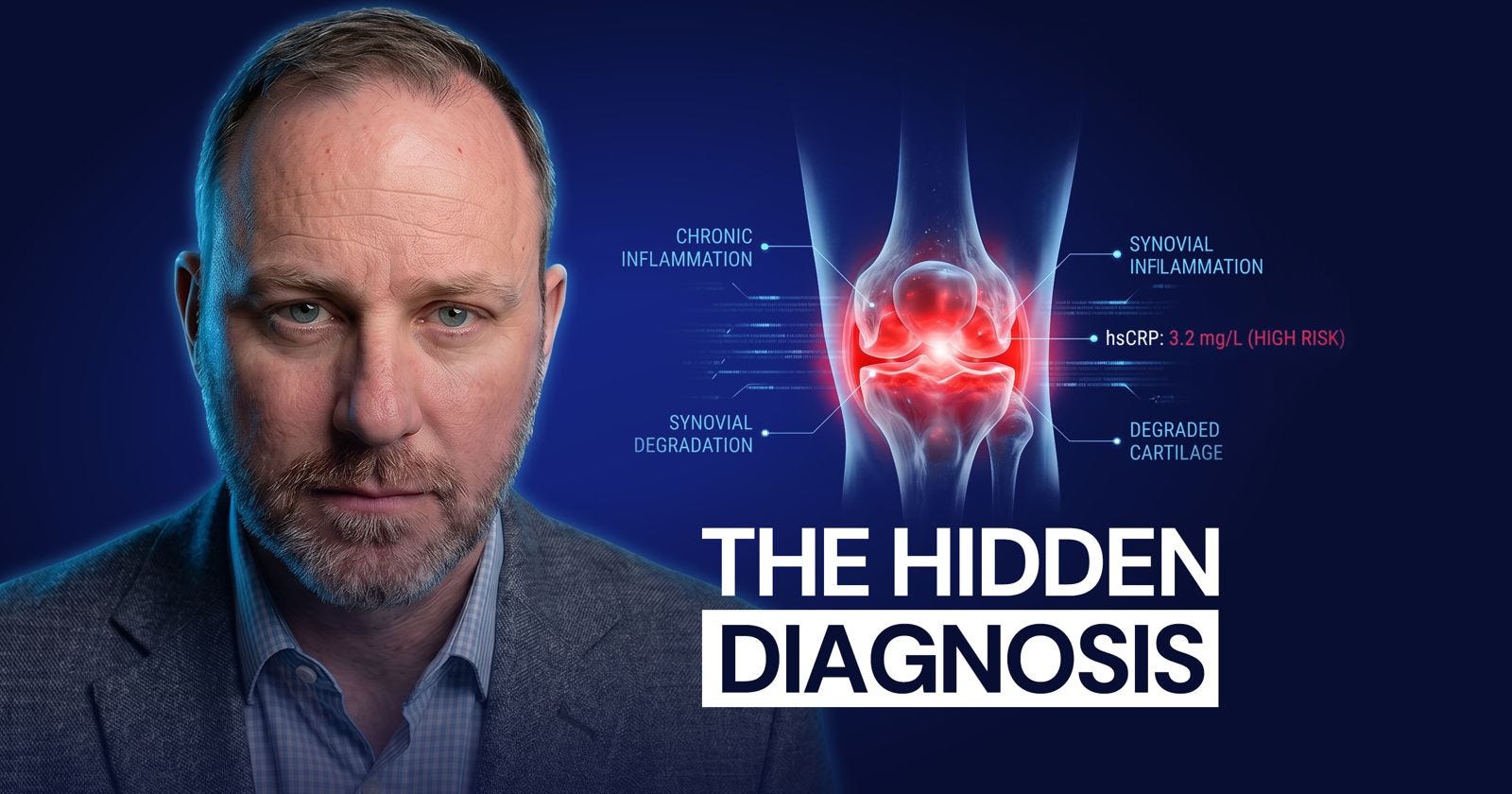
I have looked inside more than 10,000 human joints.
I can tell you things about the human body that do not show up in textbooks. I can tell you what a life of chronic stress looks like in synovial tissue. I can tell you the difference between a joint that has been quietly inflamed for a decade and one that has not.
What I see more than anything else, in patient after patient, year after year, is the same thing.
Inflammation. Systemic, chronic, low-grade, and almost entirely invisible until it is not.
The frustrating part is not that this is happening. The frustrating part is that we have the tools to detect it early, the knowledge to address it directly, and a medical system that has organized itself almost perfectly to do neither.
I know this because I almost missed it in myself.
The Silent Driver Nobody Is Naming
Chronic low-grade inflammation is the common upstream driver of the four leading causes of death in America — cardiovascular disease, cancer, diabetes, and Alzheimer’s disease.
Not a contributing factor. The upstream driver.
A landmark analysis published in Nature Medicine in 2023 examined data from nearly 45 million patients and concluded that chronic inflammation is implicated in more than 50% of all deaths globally. The inflammatory cytokine interleukin-6, elevated C-reactive protein, and chronic activation of the NF-kB signaling pathway appear across the pathology of heart disease, type 2 diabetes, multiple cancers, and neurodegenerative disease with a consistency that is no longer scientifically debatable.
We are not talking about the acute inflammation that heals a wound. That version is one of the most elegant systems in biology. We are talking about its chronic, dysregulated cousin — the kind that never fully switches off, that quietly degrades tissue over years and decades, that shows up in your bloodwork as a whisper long before it announces itself as a diagnosis.
Your annual physical is almost certainly not testing for it.

What the OR Taught Me
I started noticing a pattern years into my surgical career.
Two patients, similar age, similar weight, similar preoperative function scores. I open the first joint and the tissue is relatively healthy. I open the second and it is a different story entirely — inflamed synovium, degraded tissue quality, a joint that looks biologically a decade older than the chart suggests.
The difference was not always explainable by diagnosis alone. It was systemic.
I started asking more questions. Diet. Sleep. Stress. Movement. The answers were predictable in their consistency. Then I ran my own labs — and found markers I did not expect in someone performing, by every external measure, at a high level.
That was the moment I understood this personally, not just clinically.
The association between systemic inflammation and poor surgical outcomes is well-documented. Elevated preoperative CRP is an independent predictor of complications after joint replacement. Metabolic syndrome substantially increases infection risk, wound complication rates, and implant failure. I was seeing the end stage of a process that had started silently, years earlier, that nobody had ever named for these patients.
The System Is Built to Miss It
We are organized to treat disease, not to prevent it. And chronic inflammation sits in the gap between the two.
Your annual physical screens for acute illness and manages established diagnoses. It is a liability screen dressed up as a health assessment — almost entirely backward-looking. It identifies what has already gone wrong, not what is quietly accumulating.
High-sensitivity CRP — the most accessible and clinically validated marker of systemic inflammation — is not standard on most wellness panels. It costs a few dollars to run. The JUPITER trial, published in the New England Journal of Medicine in 2008, enrolled nearly 18,000 patients with normal LDL but elevated hsCRP and demonstrated that treating the inflammatory burden reduced cardiovascular events significantly.
That was 2008. Seventeen years ago. hsCRP is still not standard of care.
The system is not failing by accident. Prevention does not bill. Chronic disease management does. That is not cynicism. That is an incentive structure.
And then there is the NSAID problem.
Americans consume approximately 30 billion doses of NSAIDs annually. They are the default response to the pain and stiffness that chronic inflammation produces. They do not address inflammation. They suppress its signal.
Long-term NSAID use carries documented risks. A 2017 meta-analysis in the British Medical Journal examining more than 446,000 patients found that all common NSAIDs were associated with significantly elevated risk of acute myocardial infarction — with risk emerging within the first week of use.
We are managing the signal of chronic inflammation with a drug class that, at population scale, is generating its own cardiovascular burden. This is what symptom suppression without root cause resolution looks like in practice.
Two Things You Can Do This Week
Ask for hsCRP on your next blood panel.
It is inexpensive, widely available, and requires no special preparation. Optimal is below 1.0 mg/L. Above 2.0 mg/L represents elevated cardiovascular risk. Above 3.0 mg/L is high risk. If you are above 2.0 and nobody has discussed it with you, you are in the gap the system is not designed to address. While you are at it, ask for homocysteine — independently associated with cardiovascular disease, cognitive decline, and systemic inflammatory burden. Both tests together cost less than a co-pay.
Remove the fuel.
Chronic inflammation has inputs. The most powerful modifiable ones, ranked by the strength of the evidence: diet first — ultra-processed food, refined seed oils, and added sugar directly drive the NF-kB inflammatory pathway. Sleep second — a single night of poor sleep measurably elevates IL-6 and TNF-alpha. Movement third — resistance training specifically produces anti-inflammatory myokines through skeletal muscle; a sedentary body is an inflamed body. Chronic stress fourth — sustained cortisol elevation drives inflammatory gene expression, documented in the psychoneuroimmunology literature for thirty years.
None of these require a prescription. None generate revenue for the sick-care system. All of them work.
Treat the Root, Not the Branch
Every chronic disease conversation you will have with a doctor is a branch conversation. Statins for cholesterol. Metformin for blood sugar. NSAIDs for joint pain. Clinically appropriate in many contexts. Entirely silent on the root.
The root is inflammation.
The branch conversations are not wrong. They are incomplete. And incomplete, at population scale, over decades, is how you end up with a country where chronic disease is the norm and the healthcare system calls it inevitable aging.
It is not inevitable. Ask for the test. Change the inputs. Have the root conversation.
That is the incision point.
What markers is your doctor running? AND, what’s missing from your panel?
Tell me below.
Dr. Michael Meneghini