
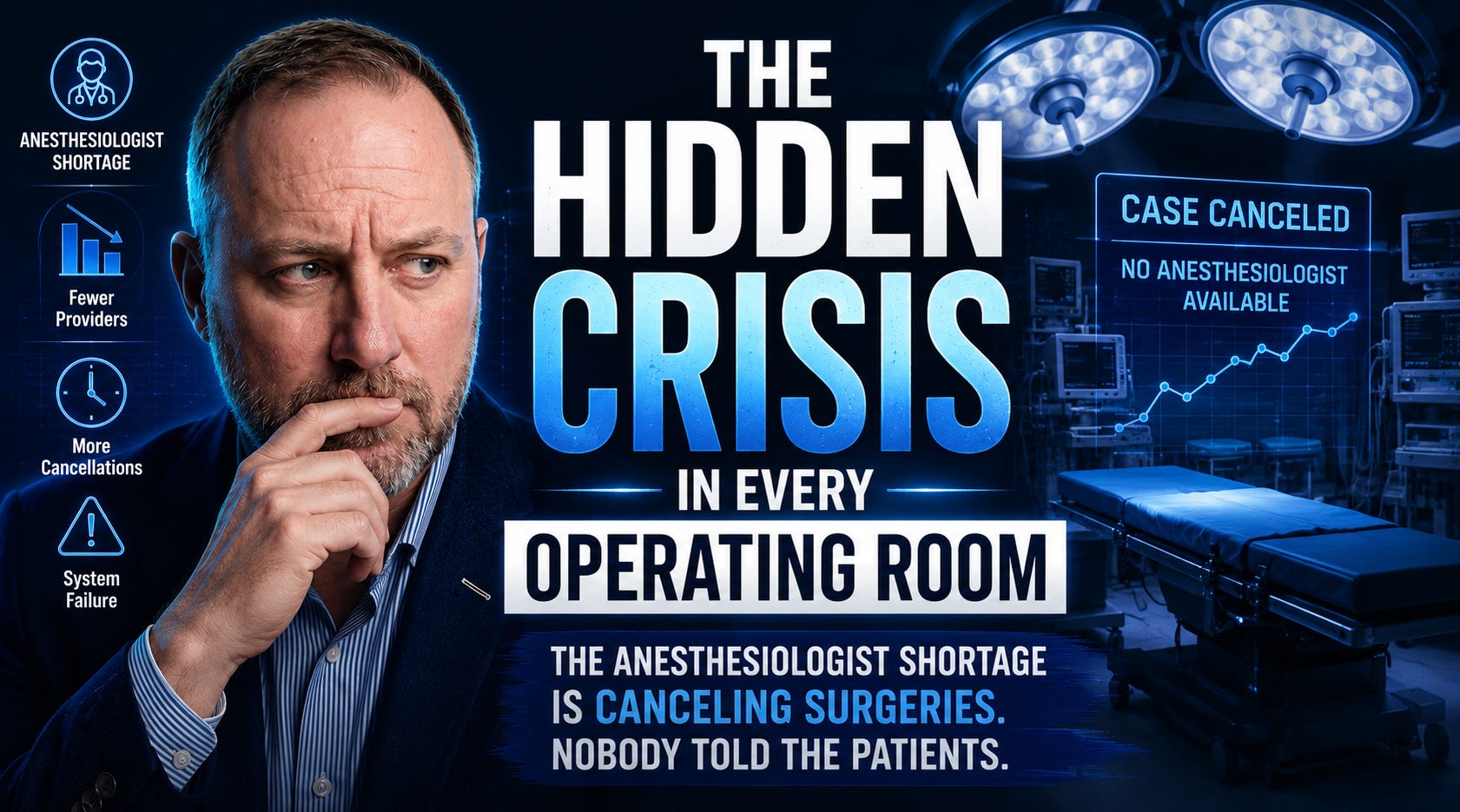
Your surgery is scheduled. You’ve done the prep. You’ve arranged time off work. You’ve had the pre-op conversation with your surgeon.
What nobody told you is that the person who keeps you alive during that procedure, the anesthesiologist, may not be there.
This is not a hypothetical. This is the operational reality of American healthcare right now, and it is accelerating. The anesthesia crisis is a slow bleed that patients don’t see, administrators are scrambling to manage, and surgeons are watching reshape their entire operating model in real time.
I’m going to tell you exactly what’s happening. And why it matters for every single person who might ever need a surgery, which is to say: everyone.
Why the Pipeline Is Running Dry
Start with the numbers. Nearly 30% of anesthesiologists are projected to leave the workforce by 2033, leaving an anticipated shortfall of 12,500 providers. A separate projection puts the gap at 6,300 anesthesiologists by 2036. Choose whichever number you find more comforting. Neither one is acceptable.
The core driver is an aging workforce compounding against frozen training capacity. Fifty-nine percent of practicing anesthesiologists are 55 or older, with 17% nearing retirement age. The average age of an anesthesiologist in 2020 was 52.6. You don’t need a medical degree to see where that trajectory leads.
Then there’s the pipeline. In the 2025 Match, 1,805 PGY-1 anesthesiology residency positions were offered to more than 3,000 applicants, leaving over 1,200 unmatched. More than 1,200 people who wanted to become anesthesiologists were turned away. Not because they weren’t qualified. Because the federal government, through the Centers for Medicare and Medicaid Services, has effectively capped residency positions since 1997. CMS has maintained Medicare-funded GME position caps with minimal growth in anesthesiology residency positions despite major demographic shifts.
That is a policy failure masquerading as a market problem.
Burnout is pouring fuel on an already-burning house. Anesthesiology leads all physician specialties in burnout, with 40.6% of anesthesiologists planning to leave their current roles within the next two years. The specialty’s 2024 burnout rate was 50%, driven by long hours, limited autonomy, and administrative burdens such as prior authorizations.
And COVID accelerated everything. The older population of anesthesia clinicians who may have been on the cusp of retiring said “I’m done with this” when COVID arrived. And they left. They did not come back.

How Hospitals Are Winning the Bidding War, and Who Loses
Here’s what patients don’t see from the waiting room.
Hospital systems and ambulatory surgery centers, the physician-owned outpatient facilities I built Indiana Orthopedic Institute around, are now in direct competition for the same shrinking pool of anesthesia providers. And hospitals are not competing fairly.
Large hospital systems have leverage that independent ASCs structurally cannot match. They offer guaranteed patient volume, institutional benefits, and most critically, stipends. Direct financial subsidies paid to anesthesia groups to lock in their coverage. The supply-demand curve has shifted dramatically, especially given the dire shortage of clinicians and the no-holds-barred attitude hospitals have taken toward supportive stipends to keep and retain clinicians.
The result: anesthesia groups that once served ASCs are being pulled toward hospital contracts. The guaranteed volume and the financial backstop are simply more attractive than the fee-for-service model ASCs traditionally offered.
ASCs are now paying for that imbalance directly. The share of ASCs expecting to pay anesthesia stipends jumped from 28% in 2024 to 44% in 2025, according to a VMG Health report. Those stipends, which were effectively nonexistent five years ago, are now approaching $200,000 at the median. In 2018, ASCs with stipends were estimated at $25,000. Today the median number is nearly 8X that, closing in on $200,000.
That cost doesn’t disappear. It gets absorbed into operating margins, compressed into the same financial models that ASCs built their value proposition around, which was: lower cost, better outcomes, more efficient care. The relatively lower reimbursement rates for ASCs, combined with these increasing costs, have made the business model much more challenging.
At the same time that ASC costs are rising, anesthesia reimbursement from payers is going the wrong direction. Average professional anesthesia reimbursement fell 5.5% from 2019 to 2023. CMS finalized a further 2.83% cut to the anesthesia conversion factor for 2025. Less reimbursement, higher labor cost, fewer providers. That is not a cycle that self-corrects.
When anesthesia coverage falls short, ASCs have reported room closures or canceled cases, creating financial strain and disrupting patient care. Room closures are not an abstraction. They are a patient who waited six months for a hip replacement, arrived at their surgery date, and was sent home.
This is already happening. Routinely.

Why This Is a Systems Problem, Not a Scheduling Problem
I want to be precise about what I am describing, because the temptation is to frame this as a staffing inconvenience that administrators can solve with better planning and a few locum tenens contracts.
That framing is wrong.
By 2023, 78% of facilities reported an anesthesia staffing shortage, compared with 35% before COVID-19. That is not a blip. That is a structural fracture. The model that assumed anesthesia coverage was a commodity, available on demand, has broken down.
The training pipeline cannot self-repair quickly. The Resident Physician Shortage Reduction Act of 2021 aims to increase residency slots by 2,000 each year across all specialties between 2023 and 2029, far less than the projected shortfall. It will take a much larger federal investment to address the projected increase in demand over the next decade. That legislation, even if it works as designed, is not remotely scaled to the problem.
Meanwhile, the aging population is driving surgical demand in the exact opposite direction from workforce supply. Older patients need more procedures. More procedures require more anesthesia coverage. More anesthesia coverage requires providers who are not there.
The demand curve and the supply curve are moving away from each other. Nobody in Congress is treating this like the emergency it is.
What Actually Has to Happen
I am not interested in just naming the problem. I have spent my career building structures that solve it. Here is what needs to happen, in order of how quickly it can be executed.
1. Expand CRNA scope of practice nationally. CRNAs’ scope of practice varies by state; however, 32 states and Washington D.C. allow CRNAs to practice independently. The remaining states are restricting access to care based on turf protection, not patient safety evidence. A nationally standardized, full-scope CRNA practice model does not solve the shortage alone. But it immediately deploys existing capacity that is currently sitting idle behind regulatory walls.
2. Unlock the GME bottleneck. Congress froze Medicare-funded residency positions in 1997. The population has grown by 70 million people since then. Expansion often follows institutional resources rather than community need, with some high-growth, low-income regions lacking adequate training pipelines. Federal investment needs to be redirected toward high-need geographic areas, not prestige academic centers that have adequate coverage already.
3. ASCs must restructure the anesthesia relationship. The old model is finished. Historically, anesthesia groups operated on a fee-for-service model, anesthesiologists billed per case, and ASCs rarely needed to subsidize coverage. That model has unraveled. Forward-looking ASCs are already treating anesthesiologists as essential partners in the business model, not third-party contractors. Some are bringing anesthesia in-house. Some are building equity partnerships that align incentives. This is the structural correction that produces durable coverage.
4. Fix scheduling efficiency. A significant share of the operational crisis is amplified by poor OR scheduling. Anesthesia groups were providing anesthesiologists but ORs were sitting empty, so they weren’t making enough revenue to justify coverage. Efficiency is not a soft operational goal. It is a financial survival requirement. One ASC in New York flipped the model: instead of paying stipends to the anesthesia group, surgeons now pay a fee if they fail to fill their assigned OR block. Case volume went up. Coverage stabilized. That is engineering applied to an operational problem.
5. Reimbursement reform is not optional. The payer system is actively making this worse. Average anesthesia reimbursement fell 5.5% from 2019 to 2023. CMS cut the anesthesia conversion factor another 2.83% in 2025. You cannot solve a workforce crisis by simultaneously making the workforce less financially viable. Advocating for reimbursement reform is not optional for any surgical leader who wants to operate in five years.

What I’m Telling My Colleagues
I sat in a planning meeting recently where we were mapping out OR expansion at Indiana Orthopedic Institute. The first question wasn’t about equipment or volume. It was: who is putting someone to sleep in these rooms?
That question is now the central operational constraint in outpatient surgery. It wasn’t five years ago.
Surgeons who built their practices around the ASC model, including me, have to reckon with the fact that the value proposition we offered patients, better outcomes, lower cost, more dignity than a hospital corridor, is under structural threat. Not from regulation. Not from competition. From a workforce pipeline that the federal government allowed to calcify for 30 years while the population aged.
This is a fixable problem. But it does not fix itself. It requires policy action at the federal level, structural reinvention at the ASC level, and surgeons willing to engage with it as an operational priority, not someone else’s administrative headache.
Your patient is on the table. The surgeon is scrubbed in. The lights are on.
The room is ready. The question is whether the person keeping that patient alive is too.
That is the crisis no one is talking about. I am talking about it.