


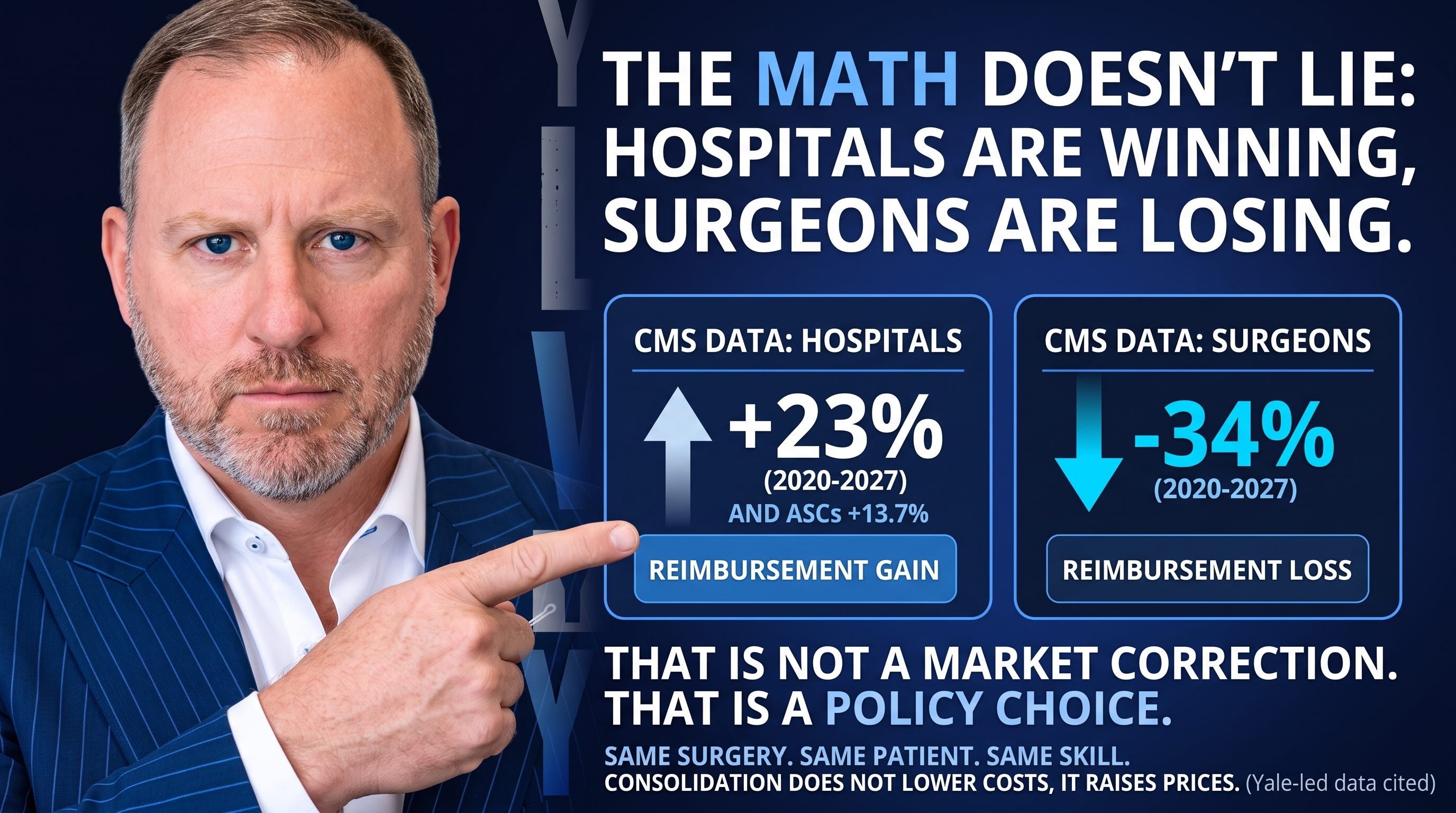
I pulled the CMS reimbursement data myself. From 2020 to 2027, for the exact same total knee replacement, hospitals will see their payment go up 23%. Ambulatory surgical centers will see theirs go up 13.7%. Surgeons will see theirs go down 34%.
Same surgery. Same patient. Same skill in the OR.
That is not a market correction. That is a policy choice, and I intend to say so plainly.
Why I’m the One Pulling These Numbers
As current President of the American Association of Hip and Knee Surgeons, I have access to something most commentators don’t: our own Member Needs Survey data, collected directly from the surgeons living this reality. I didn’t want anecdotes. I wanted the numbers on the record.
I also wrote about this trend directly. My commentary, “A Commentary on Orthopaedic Physician Practice Consolidation, Data Trends and Implications for Total Hip and Knee Arthroplasty,” was published in the Journal of Arthroplasty this fall. After 10,000+ joint replacements and three decades inside this specialty, I’m not theorizing about consolidation. I’m watching it happen to my own colleagues, in real time, one practice sale at a time.
The System That’s Failing: Reimbursement Policy Is Quietly Finishing the Job

For years, the story we were told was that outpatient shift, site-neutral policy discussions, and value-based care would rebalance who gets paid what in American healthcare. Look at the CMS trend line for CPT 27447, the code for total knee arthroplasty, and you’ll see the opposite happening.
Hospitals: up 23%. ASCs: up 13.7%. Surgeons: down 34%.
That’s not a rounding error. That’s a seven-year, government-published trajectory that systematically shifts value away from the person doing the operation and toward the entities that own the building around them.
The Numbers Nobody in Power Wants to Say Out Loud
Here’s what the AAHKS data actually shows.
In 2009, only 7.1% of AAHKS members were hospital employees. By 2025, that number hit 31.4%.
In 2012, more than 60% of physicians nationally worked in private practice. Today it’s 42.2%.
That is not surgeons choosing employment because it’s better for patients. That’s surgeons being squeezed out of independence because the reimbursement math no longer supports staying independent.
“That’s not a market correction. That’s a policy choice.”
And here’s the part that should worry anyone who thinks consolidation is about efficiency: it doesn’t lower costs. It raises them.
A Yale-led analysis, published through the NBER and cited in support of my commentary, tracked what happens after hospitals acquire physician practices. Two years post-acquisition, hospital prices rose 3.3%. Physician service prices for the same care rose 15.1%. There was no measurable improvement in quality attached to either increase. The researchers concluded the price growth came from reduced competition, not better care.
We are being told this consolidation wave is about efficiency. It is about leverage.
The Personal Reckoning: I Almost Believed the Easy Version of This Story
I’ll be honest about something. Early on, I understood consolidation the way most people outside of it do, as an inevitable, almost natural drift toward scale. Bigger systems, more resources, presumably better care. I had to unlearn that.

When hospitals own the surgeons, hospitals control where the surgery happens. Even when CMS policy is actively nudging joint replacement toward lower-cost ASC settings, consolidation pulls it right back into the highest-cost setting there is. I watched that contradiction play out in real boardrooms, not in a policy paper.
I didn’t build Indiana Orthopedic Institute to fight this quietly. I built it because I refused to accept that the only two options for a surgeon were sell out or get squeezed out. We went from two people to over 100 employees and 16 surgeons in three years, built on the idea that independent, physician-owned care could still compete, and win, against consolidated systems.
The Blueprint: What Surgeons and Patients Can Actually Do
This isn’t a story about surgeons complaining about pay. It’s a story about who controls the delivery of your care, and whether that system still has room for independent clinical judgment or just shareholders. Here’s what I tell colleagues who ask what to do about it.
If you’re in private practice, get ownership in an ASC. Bring high-quality, lower-cost care into a setting you actually control, instead of waiting for someone else to make that decision for you.
If you’re already employed, don’t disengage. Push for bundled payment models and shared savings arrangements with your hospital employer. Passive employment accelerates the trend line. Active negotiation slows it.
Get political, not partisan. Support site-neutral payment policy and wRVU protection. This is one of the rare issues in healthcare where physicians and patients are fully aligned, and that alignment is leverage.
As a patient, ask where your surgery is actually happening, and why. That single question can save you thousands of dollars with zero difference in outcome.

The Direct Challenge
To the surgeons reading this: the hospital systems will not save you. The reimbursement trend line makes that explicit, in writing, published by CMS itself. You have to build or claim your own leverage, whether that’s ASC ownership, contract renegotiation, or organized political advocacy through groups like AAHKS. Nobody is coming to fix this for you.
To the healthcare administrators and entrepreneurs reading this: if your model of growth depends on this reimbursement gap widening, you are building on a policy trend that increasingly conflicts with your own stated mission of affordable, quality care. The Yale data makes that contradiction measurable.
To patients: the question of where your surgery happens, and who owns that decision, is not a technical detail. It’s the whole story.
Are we going to let reimbursement policy quietly finish the job of eliminating physician-owned medicine? I don’t think that outcome is fixed yet. But the data says we’re closer to it than most people realize.
Where do you stand on this? I’m genuinely interested.

Challenging the status quo is essential to address these imbalances and advocate for fairer compensation models in healthcare.