


For decades, the story of a hip or knee replacement followed a very predictable script: surgery, followed by several days of hospital food, thin pillows, and the constant hum of machines. It was the “gold standard” because we believed the hospital was the only safe place to be. But the landscape is shifting beneath our feet. We are entering an era where the best place to recover might actually be your own living room.
As someone who has lived and breathed these protocols, I’ve seen this transition first-hand. It’s not just about getting people out the door faster; it’s about a massive leap forward in how we manage pain, how we operate, and how we empower you to take charge of your recovery.
This shift toward outpatient surgery is driven by a perfect storm of better technology and a deeper understanding of what the human body needs to heal. But—and this is a big “but”—it isn’t a shortcut. Doing this right requires a level of precision and preparation that is even more intense than the old hospital-based model.
The Secret Sauce of Same-Day Success
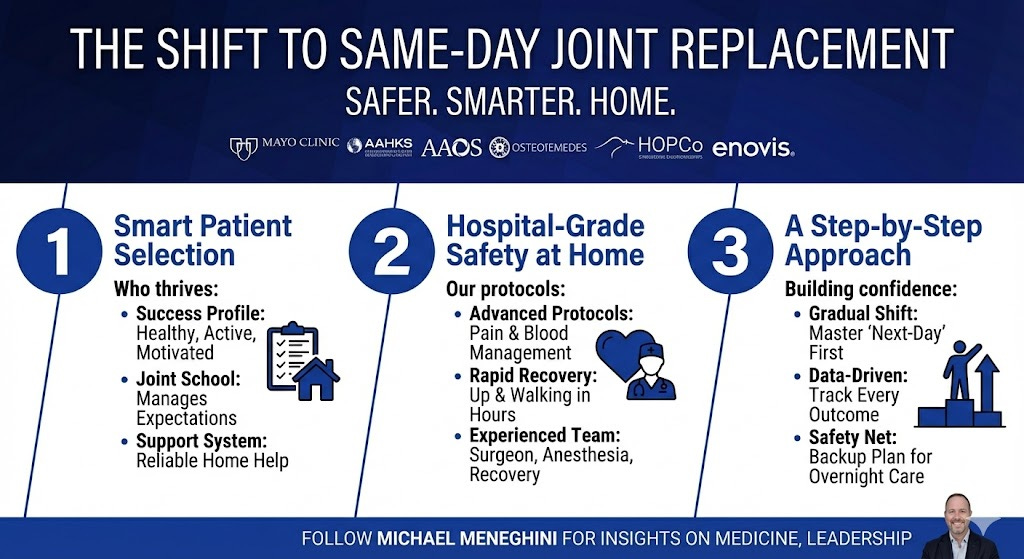
If we’re going to skip the hospital stay, we have to bring “hospital-grade” safety into the pre-op phase. It starts with what I like to call the “Success Profile.” We look for patients who are not just healthy, but who are motivated.
We’ve found that when a patient is educated through “joint schools” and knows exactly what to expect, their anxiety levels drop and their outcomes soar. You aren’t just a passive participant in this; you’re the lead actor.
This also means having a “pit crew” at home. You need a support system—family or friends—who are briefed and ready. We’ve refined our clinical protocols so tightly—from how we manage blood loss to the specific types of anesthesia we use—that most patients are up and walking just hours after the procedure. It’s a coordinated dance between the surgeon, the anesthesiologist, and the recovery team.
How We Build a Safe Path Forward
We don’t just flip a switch and start doing every surgery as an outpatient procedure. It’s a disciplined, step-by-step process. We typically recommend a “step-down” approach:
Mastering the “Next-Day” Discharge: First, we ensure we can consistently and safely get patients home the morning after surgery.
Data-Driven Decisions: We track everything—surgical times, readmission rates, and even minor complications—to make sure the data supports the move to same-day release.
The Safety Net: Safety is our north star. If a facility doesn’t have a seamless plan to transfer a patient to a full hospital in an emergency, it’s not ready for outpatient surgery.
Your Quick-Start Guide to Outpatient Success
If you are considering a same-day joint replacement, here are the non-negotiables you should look for:
Be Your Own Advocate: Ask your surgeon for their specific data on surgical time, blood loss, and readmission rates for outpatient procedures.
Prioritize Education: Enroll in a “Joint School” program to learn exactly how to manage your recovery at home.
Secure Your Support: Ensure you have a family member or professional support person ready to assist you for at least the first 24–48 hours.
Ask About the “Back-Up Plan”: Always confirm that there is a protocol in place for an overnight stay if you aren’t ready to go home on the day of surgery.
Key Citations & Further Reading
Berger RA, et al. (2004). Rapid rehabilitation and recovery with minimally invasive total hip arthroplasty. Clin Orthop Relat Res.
Dorr LD, et al. (2010). Outpatient total hip arthroplasty. J Arthroplasty.
Meneghini RM, et al. (2017). Safe selection of outpatient joint arthroplasty patients with medical risk stratification: the “outpatient Arthroplasty risk assessment score.” J Arthroplasty.
Stambough JB, et al. (2015). Rapid recovery protocols for primary total hip arthroplasty can safely reduce length of stay without increasing readmissions. J Arthroplasty.

Preparation and ownership always beat comfort in outcomes like this.
I love your visual! I’m an anesthesia provider (CRNA) and former Executive Director of a surgical center. Would it benefit you as a surgeon to include a section on what to expect during recovery/afterwards so your patients know that is the expectation? Just a suggestion. Some food for thought.