


The year was 1999. I was 26 years old, standing in a cramped bathroom at Cook County Hospital in Chicago, fighting back tears.
I was an orthopedic intern, exhausted beyond logic. At that time, there were no residency work-hour restrictions. I was averaging 120 hours a week, on every-other-night call for trauma and vascular surgery. My father had just died of a massive heart attack at the age of 50. I was grieving, I was sleep-deprived, and I was, for the first time in my life, staring at the precipice of being “broken.”
Minutes earlier, an attending faculty surgeon had verbally demoralized me. He wasn’t just correcting a mistake; he was being abusive. In that moment, the profession I had dreamed of joining my entire life felt like it was rejecting me.
I had two choices: let that moment define my failure, or let it forge my resolve.
I chose the latter. I decided right then that no other human being was going to determine my fate. I was going to stand back up, bloody but unbowed, and I was going to fight with a determination that would never be questioned again.
That is Grit.
What is Grit, Really?
Angela Duckworth, the best-selling author and academic, famously defined grit as “passion and perseverance for long-term goals.” It is the ability to maintain interest and effort toward very long-term goals despite adversity, failure, and plateaus in progress.
In my case, it was the realization that my value was not tied to the verbal abuse of a superior, but to my own commitment to the patient and the craft.
But as I look back on that 26-year-old version of myself, I find myself asking the same questions many of you likely struggle with in your own leadership journeys:
Is grit innate? Was I born with a “persistence gene”?
Is it developmental? Was it forged in those first five years of life—the formative window where the brain develops most rapidly—watching my mother work three jobs to get her master’s in mathematics?
Most importantly: Can grit be learned as an adult?
The Science of Survival: What the Data Says
We often view grit as a “soft skill,” but the data from our nation’s top institutions tells a different story. It is a measurable, protective factor for high-level performers.
The Protective Power of Grit: Research from organizations like the Mayo Clinic has shown that grit is a primary defense against professional exhaustion. In studies of residents in high-stress specialties, those with high grit scores had 74% lower odds of experiencing burnout compared to their peers. Grit isn’t just about working harder; it’s about the psychological endurance that keeps you in the game when the stakes are highest.
The Malleability of Success: At Stanford University, Professor Carol Dweck’s pioneering work on “Growth Mindset” has demonstrated that when individuals believe their abilities can be developed, their persistence sky-rockets. In various high-performance environments, brief interventions aimed at shifting a “fixed” mindset to a “growth” mindset have been shown to shrink achievement gaps and increase persistence by as much as 35% to 50%.

The Malleability of Resilience
These statistics suggest that resilience is not a fixed trait. It is a muscle.
In the surgical world, we are constantly analyzing outcomes. If a component fails, we don’t just walk away; we study the metadiaphyseal fill, the seating height, and the surgical technique to ensure it doesn’t happen again. We should apply that same rigorous analysis to our own mental fortitude.
1. The “Why” is the Foundation
Grit requires a “why” that is bigger than your “what.” If I was working 120 hours just for a paycheck, I would have quit that night in Chicago. I stayed because I was obsessed with the engineering of the human body and the mission of restoring mobility. To build grit, you must tether your daily grind to a long-term vision that makes the “bloody moments” worth it.
2. The Power of “Not Yet”
In my engineering background at Rose-Hulman, failure was just data. A bridge that falls down isn’t a sign that you aren’t a bridge builder; it’s a sign that the current design needs iteration. Adult learners can develop grit by reframing failure as a “non-optimal outcome” that requires a change in protocol.
3. Deliberate Exposure to Hard Things
You cannot learn to survive a storm in a calm sea. As leaders and surgeons, we often try to optimize our lives for comfort. But grit is developed in the “trauma and vascular” shifts of life. If we want to teach our residents, our employees, and our children grit, we have to stop protecting them from every hard moment.
Can We Teach It?
As the CEO of the Indiana Orthopedic Institute and President of AAHKS, I spend as much time mentoring as I do operating. I believe we can teach grit, but not through a lecture.
We teach grit by:
Modeling it: Letting our teams see us handle a complication with composure and transparency.
Creating High-Stakes, High-Support Environments: Pushing people to the edge of their capability while providing the psychological safety to know that a “knock-down” isn’t a “knock-out.”
Standardizing the Response to Failure: Much like we use the Delphi Consensus Criteria to define surgical success, we need a “consensus criteria” for how we handle professional setbacks.
Standing Back Up
That night in 1999 shaped the surgeon I am today. It taught me that excellence isn’t just about “very good hands”—it’s about the ability to “still yourself in the craziest situations.”
If you are currently in your own “hospital bathroom moment,” wondering if you have what it takes: Decide.
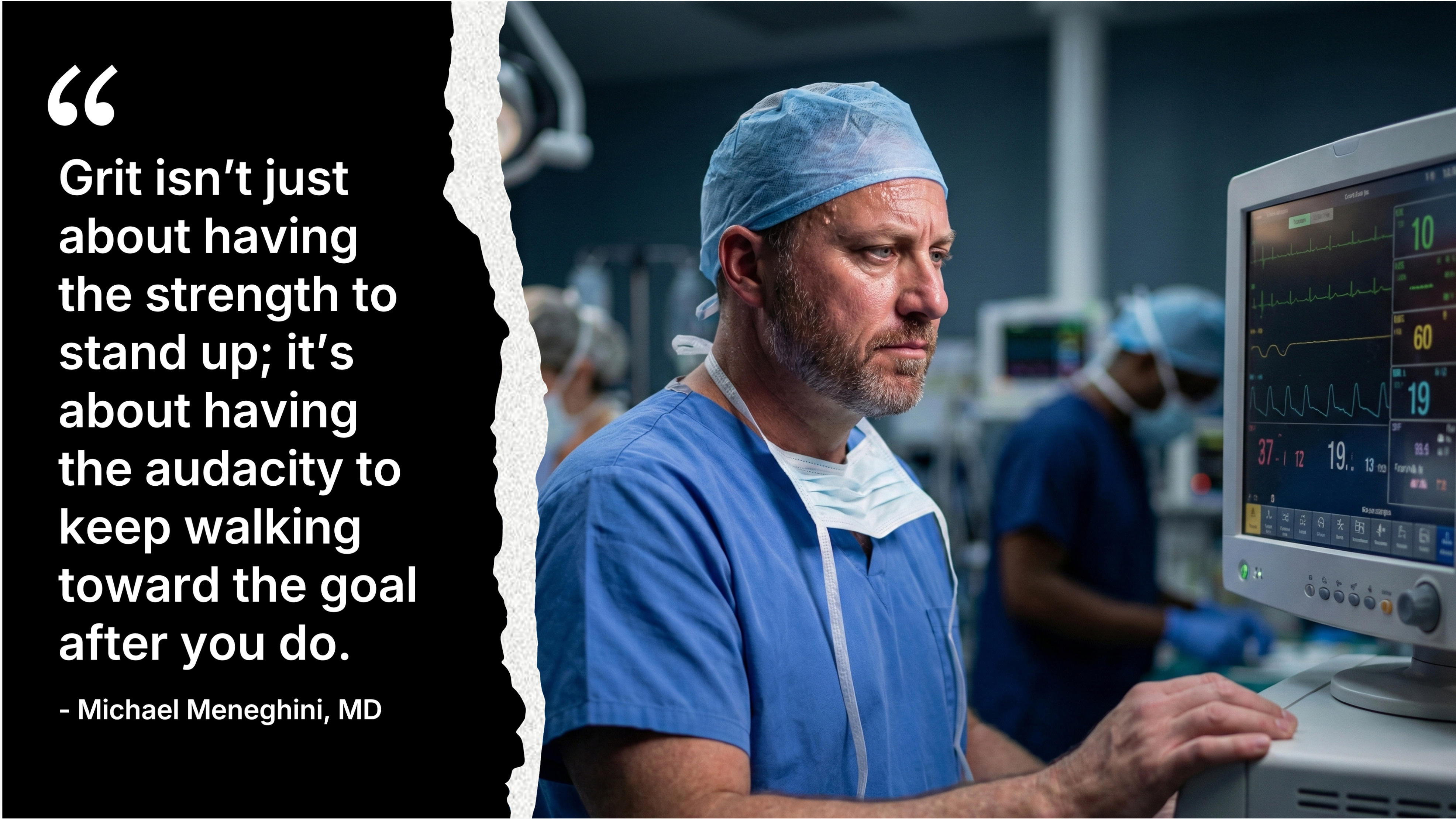
Decide that your fate belongs to you. Grit isn’t just about having the strength to stand up; it’s about having the audacity to keep walking toward the goal after you do.
What was the moment that forged your grit? I’d love to hear your story in the comments.

Thanks for sharing your story and expertise with grit and resilience. Very inspiring.
Great Article.
“There is a grit and punk edge to his songs yet a presence of loss as well, heartache and self punishment thrown in for good measure”.
Larry Lamon (The Ohm)
https://andybrowneofficial.com/
“My Favorite Sweater”
https://youtu.be/DzRnoKpip1U?si=RMlNr9v05MpKUTYi