



I sat in a hospital boardroom early in my career. The conversation was about productivity. Specifically, about RVU targets for the surgical department. Relative Value Units, the metric hospitals use to measure how much billable work a physician generates in a given period.
The administrator running the meeting had never operated. Had never stood at a table for eight hours managing a complication. Had never had a patient look at them before anesthesia and say, “I trust you.”
He had a spreadsheet. And the spreadsheet said I was not producing enough.
I left that meeting with a clarity I have carried ever since. The system was not designed to make patients healthier. It was designed to generate units. And I was the unit generator.
That was the moment I started building something different.
The Numbers Behind the Takeover
The transformation of American medicine from a physician-led profession to a corporate employment structure has been the most consequential change in healthcare delivery over the past two decades. Most patients do not know it happened. Most physicians feel it every day but rarely say so publicly.
The American Medical Association has tracked physician practice ownership since 2012. The trend line is unambiguous.
In 2012, 60.1% of physicians worked in private practice. By 2024, that share had dropped to 42.2%. In the same period, the share of physicians working in hospital-owned practices rose from 23.4% to 34.5%, and physicians employed directly by or contracted with hospitals doubled, from 5.6% to 12.2%.
Only 35.4% of physicians had an ownership stake in their practice in 2024, down from 53.2% in 2012, and less than half the roughly 76% share estimated in the early 1980s.
In one generation, American medicine went from a profession where three quarters of physicians owned their practice to one where fewer than four in ten do. The physician went from the business owner to the employee. And with that shift, the entire incentive architecture of care changed.

What an RVU Actually Is
Most patients have never heard of a Relative Value Unit. Most physicians wish they could say the same.
The RVU system was developed in the 1980s as a mechanism for standardizing Medicare payments. Each clinical procedure and encounter is assigned a unit value based on estimated physician work, practice expense, and malpractice cost. Hospitals and health systems then set productivity targets based on RVU generation. Meet your target, you are in good standing. Miss it, the conversation with your supervisor begins.
The logic seems rational on paper. Measure what physicians do. Compensate accordingly.
The reality is something else entirely.
Current RVU-based systems strip physicians of autonomy, creativity, and deeper professional satisfaction. The pursuit of RVUs becomes a primary driver in medical decision-making.
When the metric that determines your compensation and employment security is the number of billable units you generate, the clinical question “what does this patient need?” becomes entangled with the financial question “what generates the most RVUs?” Those two questions do not always have the same answer. And in a production-driven environment, the financial question tends to win.
The patient who needs a longer appointment. The complex case that requires thinking, not doing. The conversation about prognosis that generates zero units and takes forty-five minutes. These are the things the RVU system punishes. Not because anyone designed it to punish good medicine. But because the metric does not measure good medicine. It measures throughput.
What Happens to the Physician Inside the Machine
I want to be honest about what the corporate employment model does to a physician over time, because it is something most doctors will not say publicly while they are still inside it.
It starts subtly. The EMR dashboard appears. Your productivity ranking relative to peers is visible in real time. Your RVU count is reviewed quarterly. A nurse manager begins attending your scheduling meetings. Clinical decisions that were once yours alone, what imaging to order, which patients to prioritize, how long an appointment needs to be, start requiring approval from administrators whose clinical credentials do not qualify them to make those decisions.
The language changes too. Patients become “encounters.” Appointments become “throughput.” The OR schedule becomes a “production calendar.” I watched this language arrive in hospitals where I trained and worked, and I watched what it did to the physicians around me.
The RVU model plays a significant role in the burnout crisis by incentivizing volume over quality, forcing physicians to churn through patients to meet productivity quotas. Over 50% of physicians report feeling burned out.
Burnout is the word we use because it sounds like a systems problem rather than a moral one. What I observed in those physicians was not burnout in the clinical sense. It was the progressive erosion of professional identity. The feeling, accumulated over years, that the judgment they spent a decade developing was no longer the primary variable in the room.
When physician authority erodes, patients notice, even if they cannot name what they are sensing. The appointment feels rushed. The doctor seems distracted. The plan feels formulaic. That is not a perception problem. It is an accurate reading of a clinical environment where the physician is constrained, monitored, and measured against metrics that have nothing to do with whether the patient in front of them gets better.
The Administrator Layer That Doesn’t Treat Patients
Here is what has grown as physician autonomy contracted.
Between 1975 and 2010, the number of physicians in the United States grew by 150%. In the same period, the number of healthcare administrators grew by 3,000%. That ratio has continued to shift. The people setting clinical policy, designing productivity dashboards, determining which procedures require administrative approval and which don’t, are increasingly people who have never practiced medicine.

I am not making a blanket argument against healthcare administration. Complex organizations require administrative infrastructure. Financial management, regulatory compliance, facilities coordination, these are real functions that require skilled professionals.
What I am arguing against is the inversion of authority that occurs when administrative metrics become the primary governance structure for clinical decisions. When an administrator with a spreadsheet has meaningful control over a surgeon’s clinical choices, the authority structure is wrong. Not inefficient. Wrong.
The consequences are not abstract. When patient care time is driven by administrative mandates rather than clinical judgment, negative consequences include poor quality of care and outcomes, errors, and low patient satisfaction ratings. For clinicians, the consequences include low morale, moral distress, burnout, and higher rates of staff turnover. American Speech-Language-Hearing Association
Every one of those outcomes costs money. Every one of them costs something more important than money too.
What I Built Instead
When I founded Indiana Orthopedic Institute, I made a decision that was either courageous or naive depending on who you asked at the time: physicians would lead the organization, and administrative infrastructure would serve the clinical mission, not govern it.
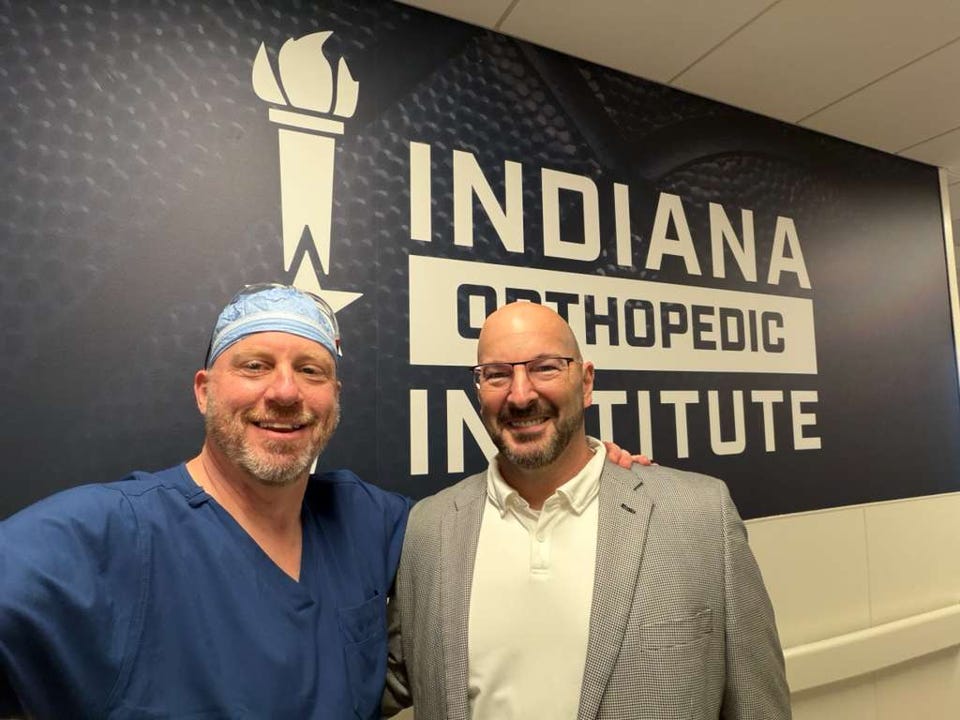
That meant the surgeon in the room has final authority on clinical decisions. It meant building our compensation model around outcomes and value, not RVU count. It meant creating an environment where a physician could take the time a patient needed without being penalized on a productivity dashboard for doing so.
We built it as an ASC-anchored model deliberately. The ambulatory surgery center structure, when physician-owned and physician-led, removes the hospital system’s leverage from the equation. The OR schedule is not a production calendar managed by a hospital administrator. It is a clinical tool managed by the surgeons using it.
The results are not theoretical. We grew from two people to over 100 employees and 16 surgeons in roughly three years. Physician retention is not a problem we manage. It is a strength we built. The surgeons at Indiana Orthopedic Institute are not looking for exits. They came here because they were looking for an alternative to the model I left.
That is not a recruitment pitch. It is evidence that the physician-led model is operationally viable, financially sustainable, and clinically superior to the production-target model that now dominates the industry.
What I Tell the Physicians Reading This
You became a physician because you wanted to make clinical decisions on behalf of patients. That instinct was correct. It is also the instinct the corporate employment model is systematically trained out of you.
The discomfort you feel when the dashboard contradicts your judgment is not a sign of poor organizational fit. It is a sign that your professional identity is intact. Honor it.
The path I took, building the alternative rather than complaining from inside the existing structure, is not available to every physician in every market. I understand that. The financial barriers to independent practice are real and have been deliberately constructed. Medical school debt, credentialing complexity, payer contracting leverage, hospital employment contracts with restrictive covenants, all of these are features, not bugs, of a system designed to make physician independence as difficult as possible.
But the path exists. The ASC model exists. Physician-owned group practice exists. The regulatory environment is shifting in ways that, for the first time in decades, modestly favor independent practice over hospital employment.
The hospital system will tell you employment is security. It is. The same way a cage is security.
The patients you trained to serve need you making decisions based on what they need, not on what the spreadsheet values.
That is the incision point.
The best professionals I've worked with all wanted the same thing.
Ownership.
Not because they wanted control, but because they cared about the outcome.
Powerful perspective. Healthcare works best when patients come before productivity.