


I have a question I cannot stop asking.
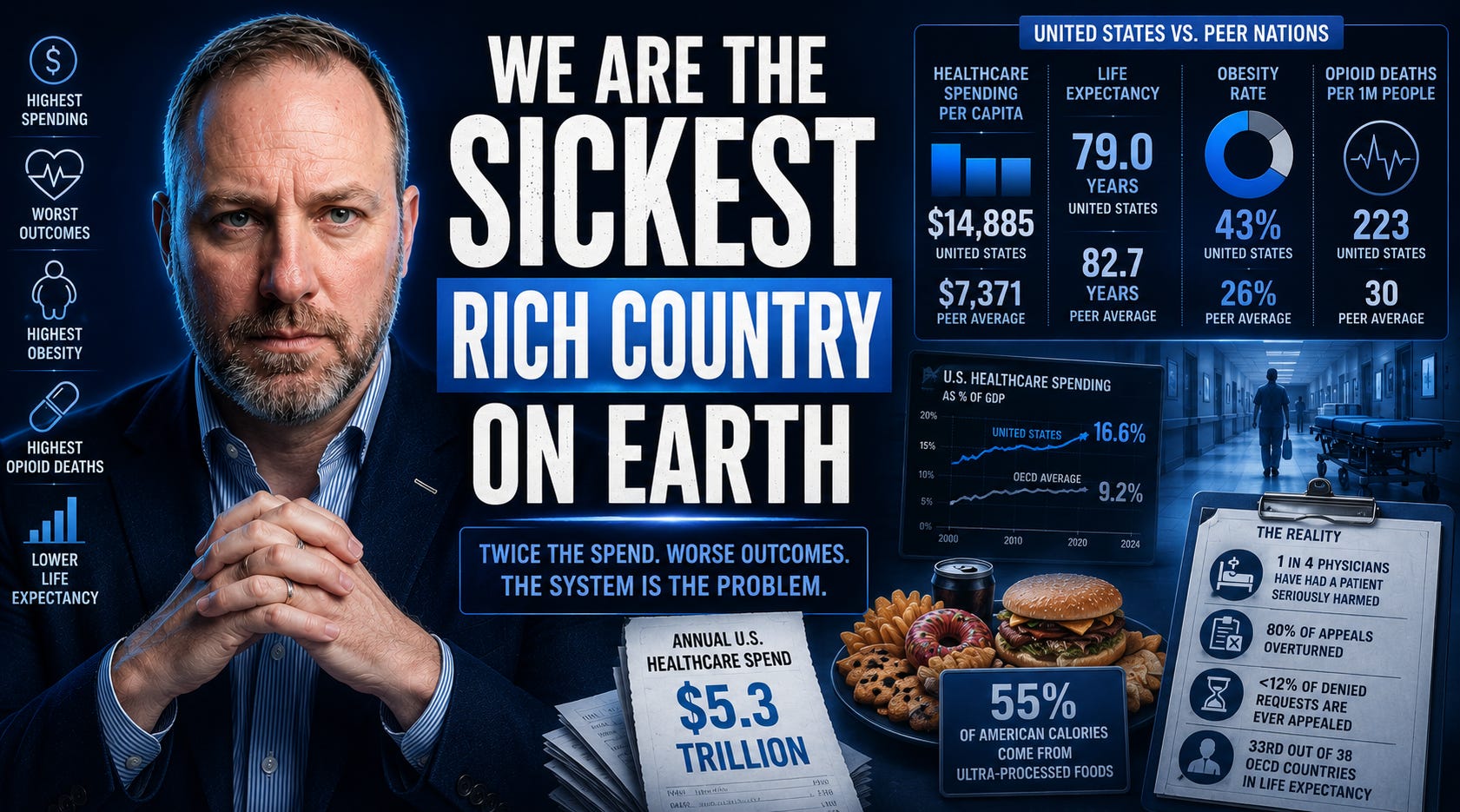
The United States spent $14,885 per person on healthcare in 2024. Switzerland, the second highest spender in the world, spent $9,963. The average among wealthy peer nations was $7,371.
We spent double what our peers spend. And according to KFF and the Peterson Center’s most recent analysis, the average life expectancy in those comparable countries is 82.7 years. In the United States, it is 79.0.
We are spending twice as much to die three and a half years sooner.
I am an orthopedic surgeon. I am also an engineer. And I can tell you with certainty: when a system consumes double the inputs and produces inferior outputs, the problem is not under-funding. The problem is the system itself.
The Numbers That Should End the Debate
Let me stack the data because it needs to be seen together, not scattered across separate news cycles.
The U.S. ranks 33rd out of 38 OECD countries in average life expectancy. The obesity rate in the U.S. is 43%, compared to an OECD average of 26%. The U.S. opioid mortality rate is 223 per 1 million people, against an OECD average of 30 per 1 million. U.S. healthcare spending as a percentage of GDP is 16.6%, against an OECD average of 9.2%.
Read those numbers in sequence. We are spending 80% more of our economic output on healthcare than the average wealthy nation. We have the highest obesity rate in the developed world. We have the highest opioid death rate. And we rank 33rd out of 38 in how long our citizens actually live.
This is not a healthcare financing story. This is not an insurance access story. Those are real problems, and I write about them directly. But they do not explain this gap. Countries with universal coverage and lower administrative overhead still do not have a 43% obesity rate. The gap between American health outcomes and peer nation outcomes is too large and too consistent to be explained by billing complexity or prior authorization.
The sickness is upstream of the healthcare system. It is being manufactured before patients ever see a physician.
55% of American Calories Come From Ultra-Processed Food

I want to be precise about what I mean by upstream, because this is where the argument gets dismissed as wellness content rather than clinical reality.
The CDC released results from the National Health and Nutrition Examination Survey covering 2021 through 2023. The finding: among Americans aged one and older, an average of 55% of total calories came from ultra-processed foods. Among children aged 18 and younger, the figure was 61.9%.
More than half of the caloric intake of the average American, including the children, comes from products specifically engineered to override satiety signaling, maximize palatability, and drive repeat consumption. The NIH randomized controlled trial published in Cell Metabolism demonstrated this mechanism directly: subjects eating ultra-processed food consumed 500 more calories per day than those eating whole food, without reporting higher hunger at baseline.
The downstream consequence of that caloric architecture, sustained over decades, is exactly the disease burden we are now spending $5.3 trillion annually trying to manage.
A 2024 umbrella review published in The BMJ, covering 45 meta-analyses and nearly 10 million people, found that greater exposure to ultra-processed foods was directly associated with a 21% higher risk of all-cause mortality, a 66% higher risk of heart disease mortality, and a 40% higher risk of type 2 diabetes.
Those are not small associations. Those are the chronic disease profile of the United States, summarized in a single study.
What I See at the Operating Table
After 10,000+ joint replacements, I can tell you something specific about the American disease burden that does not show up cleanly in life expectancy statistics.
I see it in tissue quality. I see it in the inflammatory state of joints in patients who are 55 years old but whose biological tissue architecture presents like someone 20 years older. I see it in the comorbidity list that now accompanies the average joint replacement candidate: type 2 diabetes, hypertension, obesity, metabolic syndrome. Conditions that were once exceptions are now the baseline.
The patients I operated on 15 years ago, as a group, were less metabolically compromised than the patients I operate on today. Same procedures. Meaningfully different physiological starting points.
The surgical implications are real and measurable. Higher infection rates in patients with uncontrolled diabetes. More complex soft tissue management in severely obese patients. Longer recovery trajectories in patients with significant sarcopenia. More post-operative complications across the board.
I am not describing a moral failure of individual patients. I am describing the clinical consequence of a food environment that has been systematically engineered to produce metabolic disease, combined with a healthcare system that treats the disease while leaving the engineering untouched.

The Plan Nobody in Power Will Actually Name
I want to be direct about what a real plan would require, because the political conversation keeps generating frameworks that deliberately avoid the hard parts.
A real plan would acknowledge that 55% of American calories coming from ultra-processed food is a policy failure, not a personal choice failure. The GRAS loophole allows food manufacturers to self-certify the safety of additives without independent FDA review. SNAP, the federal nutrition assistance program serving 42 million Americans, allows billions in federal spending to flow to products with no meaningful nutritional value. School nutrition standards, rolled back repeatedly under food industry lobbying pressure, govern what 30 million children eat during their developmental years.
These are not natural market outcomes. They are policy decisions. And they can be changed by policy decisions.
The MAHA commission’s report named ultra-processed food as a primary driver of the chronic disease crisis. That is the correct diagnosis. The question is whether the named diagnosis produces structural intervention or remains a talking point while the food industry’s lobbying apparatus ensures the underlying policy architecture stays intact.
I am watching. So far, the diagnosis has not produced the treatment.
A real plan would also require the healthcare system to stop being financially dependent on chronic disease management. The current system profits from treating obesity, diabetes, hypertension, and their downstream consequences. It does not profit from preventing them. That misalignment is not an accident, and it will not be corrected by adding more chronic disease management programs to a system whose incentives run in the opposite direction.
What the Engineering Lens Tells You
I trained as an engineer before I trained as a surgeon. The engineering perspective on this problem is unambiguous.
A system that spends double the input cost to produce inferior output has one of two problems: a process failure or a design failure. Process failures are fixable with optimization. Design failures require redesign.
The American healthcare system is not failing because of a process failure. Physicians are working harder than ever. Hospitals are adding capacity. Insurance companies are processing claims. The machine is running.
The design is wrong.
The design treats disease management as the primary product and prevention as an optional service. The design funds research into pharmaceutical interventions while dramatically underfunding food environment research and policy. The design allows the entities most responsible for the chronic disease burden, the food industry and the pharmaceutical industry, to be among the most influential voices in the policy rooms where solutions are theoretically being developed.
At Indiana Orthopedic Institute, I built the organization around a different design premise: patient-centered care, clinical research, and innovation working in alignment, with the physician’s judgment at the center. It is a small-scale proof of concept. The macro problem requires macro redesign.
But the redesign starts with a decision to stop calling this a healthcare problem and start calling it what it actually is: a food system problem with healthcare consequences we are billing at $14,885 per person per year.

What Has to Change
To the patients reading this: the system is not going to fix this for you. Understanding that 55% of American calories are ultra-processed is not a wellness insight. It is a survival fact. The data on what that food architecture does to your metabolic health, your inflammatory state, your long-term mortality risk, is not ambiguous anymore.
To the physicians and healthcare leaders: stop accepting the premise that chronic disease is the natural condition of an aging American population. It is not natural. It is manufactured. And our clinical protocols need to reflect that the patient’s food environment is as relevant to their surgical or medical outcome as their imaging or their labs.
To the policymakers: the OECD data is public. The mechanism is documented. The policy levers are identified. Every year this redesign is delayed is another year of 33rd place life expectancy, $14,885 per capita, and a 43% obesity rate in the wealthiest country in human history.
That is not a healthcare crisis. That is a choice. And it is being made, repeatedly, by people with financial interests in keeping the design exactly as it is.
The data points to structural issues that require deeper evaluation of how care is delivered and coordinated.
There's a lot to address in fixing this problem. We need to focus more on the social determinants of health, not just health as a single outcome, but the broader societal factors that affect individuals' health.