


I see the same patient over and over. The names change. The joints are different. But the story is identical.
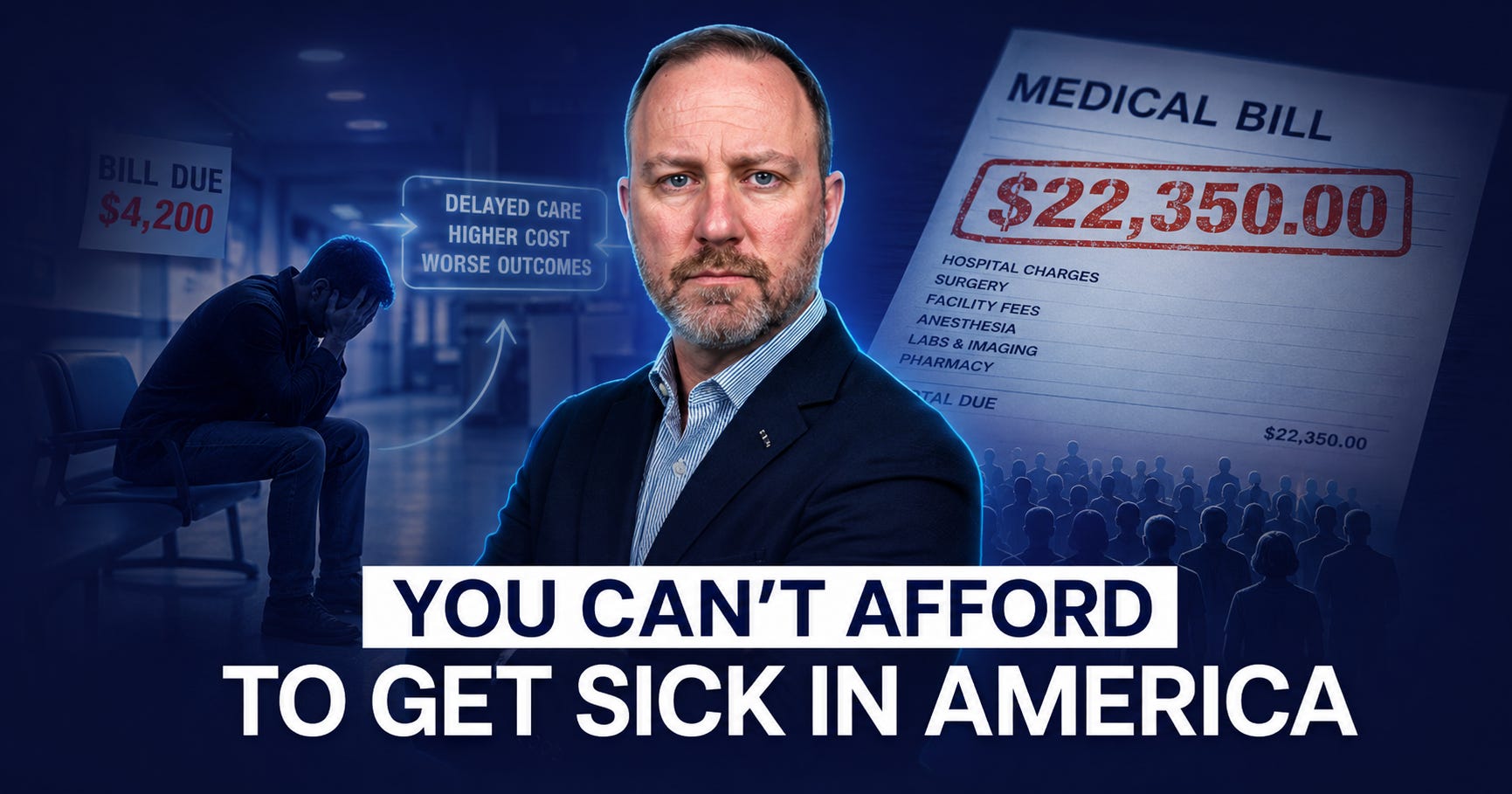
They had pain three years ago. Manageable pain. The kind where a partial procedure, a targeted intervention, a course of physical therapy might have arrested the damage and bought them a decade. They didn’t come in. Not because they weren’t in pain. Because they still owed $4,200 from the last time they interacted with the healthcare system. And they couldn’t face another bill.
So they waited. They took ibuprofen until their kidneys started to protest. They wrapped the joint. They stopped walking as far, then stopped walking much at all.
By the time they sat in my exam room, the joint was gone. Not damaged. Gone. Bone on bone. Mal-aligned. Muscles atrophied around a structure that had been mechanically failing for years. The simple procedure was no longer available. What was left was a complex total joint replacement, a longer recovery, a higher complication risk, and a bill that dwarfed the one they’d been afraid of in the first place.
The system didn’t save money by making them wait. It guaranteed they would cost more. And it guaranteed they would suffer more getting there.
100 Million People. $220 Billion. One System.
Let me give you the scale of this.
More than 100 million people in America, roughly 41% of adults, are carrying medical debt they cannot pay. That is not a fringe problem. That is nearly half the adult population of the wealthiest country in the history of human civilization.
Americans owe at least $220 billion in medical debt. Approximately 14 million people owe over $1,000, and about 3 million owe more than $10,000, according to KFF analysis of government data. And that number almost certainly understates the real burden, because it doesn’t fully capture medical charges shifted onto credit cards, loans from family members, or payment plans that patients are quietly defaulting on every month.
Medical debt is now the most common form of debt on consumer credit records. As of recent data, 58% of all debts recorded in collections were for a medical bill, according to the Consumer Financial Protection Bureau.
Not student loans. Not car payments. Not credit cards. Medical bills. The leading category of debt in collections in America is the bill you got for being sick.
And here is the clinical consequence that nobody in the finance conversation is discussing: about 1 in 7 people with health care debt say they have been denied access to a hospital, doctor, or other provider because of unpaid bills.
They are being locked out of the system by the debt the system gave them. That is not a side effect. That is the mechanism.

What Delayed Care Actually Costs
I want to be precise about what happens clinically when a patient delays musculoskeletal care because of cost.
A published analysis in The Lancet Rheumatology found that surgical delay of more than six months is associated with 50% greater odds of worse outcomes for joint replacement patients. Six months. That is the clinical window. Beyond it, the trajectory changes.
The joint continues to degrade. The surrounding musculature weakens. Compensatory movement patterns develop as the body tries to offload the damaged structure, creating secondary problems in adjacent joints, the spine, the opposite limb. A patient who needed a straightforward procedure at year one often needs a significantly more complex one at year three or four. The surgical risk profile is worse. The recovery is harder. The functional ceiling is lower.
And the cost is substantially higher, at every level: to the patient, to the insurer, to the system.
This is the economic argument that the system refuses to make honestly. Delayed care does not reduce healthcare spending. It defers it, concentrates it, and multiplies it. The patient who couldn’t afford the early intervention will eventually arrive in an emergency department, or in my OR, or in an intensive care unit. The bill will be larger. The outcome will be worse. And somewhere in the accounting, someone will record this as the cost of care rather than the cost of a system that made care inaccessible.
I have performed over 10,000 joint replacements. I can tell you with certainty: the most technically demanding cases I operate on are not the ones with the most severe underlying disease. They are the ones where severe disease was allowed to progress, unaddressed, for years. Those cases are harder. They take longer. They carry more risk. And they almost always come with a history of a patient who tried to manage the problem themselves because they could not afford to come in sooner.
The Insured Patient Who Still Couldn’t Come
I want to push back on one assumption that shapes this conversation: that medical debt is primarily a problem of the uninsured.
It is not. In the past five years, more than half of U.S. adults report they’ve gone into debt because of medical or dental bills, according to the KFF survey. That includes tens of millions of people who had insurance when the bills arrived.
High-deductible health plans have shifted enormous cost exposure onto patients. A family with a $6,000 or $8,000 deductible is, for practical purposes, uninsured for the first portion of the year. They have a card in their wallet that says they are covered. They are not covered. They are one diagnosis away from a debt they cannot service.
I have seen this repeatedly at Indiana Orthopedic Institute. A patient comes in with a plan. The deductible hits. The math changes. The follow-up doesn’t happen. The physical therapy gets cut short. The outcome suffers. The insurance company has technically fulfilled its contractual obligation. The patient is functionally on their own until the calendar resets.
This is by design. High-deductible plans reduce insurer exposure by transferring it to patients. They suppress utilization, which is the point. The suppressed utilization includes necessary care, which is the problem nobody in the insurance industry will say out loud.

The ASC as a Partial Answer
When I built Indiana Orthopedic Institute, cost transparency was not a marketing decision. It was a clinical one.
I had watched patients make medical decisions based on fear of a bill they hadn’t received yet. I had watched people delay care, ration medications, and skip follow-up appointments because the financial unpredictability of the hospital system made every interaction feel like a potential financial catastrophe.
Ambulatory surgery centers, when structured correctly, offer a fundamentally different financial model. Procedure costs are lower, often substantially. The absence of hospital overhead, administrative bloat, and facility fees compresses the price in ways that matter clinically, because price affects access, and access affects outcomes.
A patient who can afford to come in at the right time gets a better result. That is not a controversial claim. It is a clinical fact.
The broader fix requires policy that high-deductible plans don’t currently support. Price transparency requirements with real enforcement. Surprise billing protections with teeth. Medical debt reform that stops the collections machinery from blocking future care access. These are structural changes. They require political will that has, so far, been reliably outweighed by industry lobbying.
But the individual surgeon, the individual practice, the individual health system can make choices right now that reduce the financial barrier to early intervention. Transparent pricing. ASC-first pathways for appropriate cases. Financial counseling as a standard part of care coordination, not an afterthought.
What I Want You to Understand
The patient who waited too long is not a cautionary tale about personal responsibility. They are an indictment of a system that made timely care unaffordable and then charged them more for the damage the delay caused.
They did exactly what a rational person does when the financial stakes are unpredictable and the consequences of being wrong are catastrophic. They waited. They hoped. They managed.
And by the time they arrived, what could have been a repair had become a reconstruction.
The system spent $5.9 trillion on healthcare in America last year. One hundred million people still can’t afford to use it when they need it most.
That is not a resource problem. That is an allocation problem. And it is killing people slowly, one deferred appointment at a time.
The combination of high out-of-pocket costs and prior debt creates a feedback loop where patients postpone treatment, often leading to more complex and expensive interventions later.
The most maddening part is that people aren’t avoiding care because they don’t care about their health. They’re avoiding the bill.
By the time they can’t avoid it anymore, the damage is worse and the system charges them more for getting there late.