


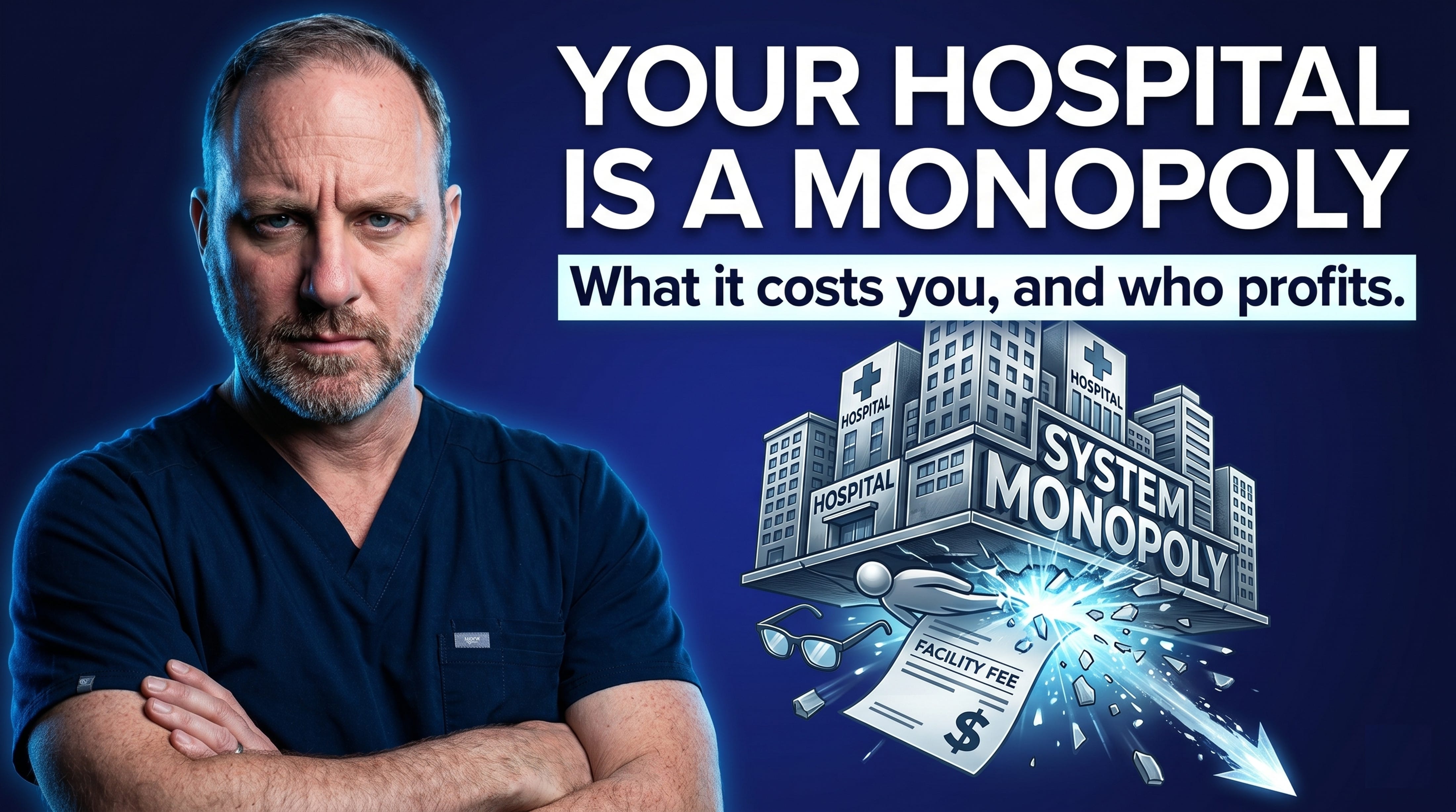
I want to tell you about a conversation I had in a boardroom, before I left the hospital system and built something different.
The discussion was about pricing strategy for a new outpatient service line. The question on the table wasn’t what the care cost to deliver, or what a patient could reasonably afford, or what a competitive market would bear. The question was: what is the maximum reimbursement we can extract given our contract position with the major payers?
I sat in my scrubs and listened to administrators who had never seen the inside of an operating room explain, with genuine enthusiasm, how the health system’s market dominance gave them pricing leverage that competitors simply couldn’t match.
I thought about my patients.
I left not long after.
That conversation is not unusual. It is the operating logic of American hospital systems in 2026. And the data now confirms, at a scale that should make every patient in this country furious, exactly how far that logic has taken us.
The Monopoly You Didn’t Know You Had
In March 2026, KFF published its most comprehensive analysis of U.S. hospital market concentration ever conducted, covering every metropolitan area in the country with 2024 data.
The findings are not subtle.
97% of U.S. metropolitan areas had highly concentrated markets for inpatient hospital care, based on the Federal Trade Commission and Department of Justice’s own thresholds for antitrust concern.
Sit with that number. 97%.
In 47% of metropolitan areas, one or two health systems controlled the entire inpatient hospital market. In more than four out of five metropolitan areas, one or two systems controlled more than 75% of all hospital care.
80% of hospital markets became less competitive between 2015 and 2024. Concentration declined in only 20% of markets.
And the share of hospitals affiliated with a larger health system? It rose from 56% in 2010 to 80% in 2024.
This is not an accident. It is the result of two decades of mergers and acquisitions, most approved by regulators who were outpaced by the relentless pace of consolidation. The hospital industry systematically bought every competitor, every physician practice, every imaging center, every surgery center it could reach. And when competition disappeared, prices moved in one direction.

What Monopoly Power Actually Costs You
The economics literature on hospital consolidation is precise and consistent.
Monopoly hospitals charge prices that are, on average, 12% higher than hospitals with three or more nearby competitors. Mergers between hospitals within five miles of each other produce average price increases of 6%. After hospital mergers in already-concentrated markets, price increases of 20% to 30% are common, with some as high as 65%. These findings come from Martin Gaynor at Carnegie Mellon University, who has testified before Congress on this topic and whose work is cited across the peer-reviewed literature and federal antitrust policy.
Elevated costs are passed directly to patients, increasing the likelihood of medical debt. With fewer alternatives and higher prices, patients delay treatment, producing worse health outcomes and even higher debt over time.
None of this shows up as a line item on your bill. It shows up as the bill itself.
And when a hospital acquires a physician practice, something changes on the bill that most patients never see coming. A facility fee appears.
Imagine going to the same doctor for years, paying your copay at each visit. Then the doctor’s office gets purchased by a hospital system. Nothing about the physical location changes. The same physician sees you. But a second bill now arrives from a hospital billing department for a facility fee you’ve never been charged before, for care that took place at the same office you’ve always used.
There is no evidence that charging hospital facility fees for outpatient care improves patient outcomes. These fees exist to improve the profit line for health care companies that own the location of care.
The facility fee is the financial mechanism of consolidation made visible on your bill. It is the hospital system reaching into the doctor-patient relationship and extracting margin from a transaction it had no clinical part in.
For orthopedic procedures specifically, the numbers are stark. Privately negotiated facility fees are on average $3,077 higher at hospitals compared with ambulatory surgery centers. For knee arthroplasty alone, the facility fee difference reaches $5,717.
I perform knee replacements every week. I know exactly what it costs to deliver excellent, data-backed, physician-directed care at a well-run outpatient facility. The gap between that number and what a consolidated hospital system charges for the same procedure is not explained by better outcomes. It is explained by market power.
The Nonprofit That Isn’t Acting Like One
Here is the part of this story that I find the hardest to discuss without raising my voice.
The largest hospital systems operating this way are, in most cases, classified as nonprofits. They pay no federal taxes. They pay no state taxes in most jurisdictions. They carry the full benefit of tax-exempt status on the explicit premise that they exist to serve their communities.
And then this happens:
The average wage of hospital CEOs rose 27.5% from 2009 to 2023, while the average pay for all other hospital employees rose 9.8%. By 2023, hospital CEOs earned twelve times what the average hospital worker earned, a gap that had grown from tenfold in 2009.
In 2024, HCA Healthcare’s CEO took home $23,799,137 in total compensation, while the median HCA employee earned $60,820, a CEO-to-worker pay ratio of 391 to 1.
And on the community benefit side: of 2,425 nonprofit hospitals evaluated by the Lown Institute, 80% spent less on financial assistance and community investment than the estimated value of their own tax exemptions. The combined shortfall across all hospitals studied was $25.7 billion, enough to erase 29% of the country’s total medical debt.
I want to be precise here. I am not arguing that executive leadership has no value, or that large organizations don’t require experienced management. I am arguing that a tax-exempt institution claiming a community benefit mission, while simultaneously using monopoly pricing power to maximize revenue, lobbying aggressively against competition and transparency, and paying its CEO hundreds of times what its frontline workers earn, is not operating as a nonprofit in any meaningful sense of that word.
Indiana Governor Mike Braun has signed legislation threatening nonprofit status for hospitals charging excessively high prices. Vermont and Massachusetts have proposed bills capping healthcare executive salaries. The political tolerance for this arrangement is eroding, on both sides of the aisle. It should.

What I Built Instead
I left the hospital system with an engineering degree from Rose-Hulman, a surgical training from Mayo Clinic, and a clear-eyed understanding of what the structural problem actually was. The incentives were wrong. The ownership model was wrong. The accountability to patients was absent.
Indiana Orthopedic Institute is physician-owned and patient-first. We have grown from two people to more than 100 employees and 16 surgeons in three years, not by extracting facility fees from patients who didn’t know they were coming, and not by using market dominance to price above clinical cost. We built it by delivering better outcomes at lower cost, and letting that record be our case.
When we perform a joint replacement, the price reflects what it actually costs to deliver excellent, evidence-driven, physician-directed care. Not what monopoly power permits. Not what the absence of a nearby competitor allows.
The gap between what we charge and what a consolidated hospital system charges for the same procedure is not a gap in quality. Study after study confirms that outcomes at physician-owned ambulatory surgery centers are equivalent to hospital-based care for appropriate procedures, at a fraction of the cost. The gap is the facility fee. The overhead. The administrative layer. The executive compensation. The margin of a system that has spent decades removing its own competition.
What Needs to Change
This does not resolve itself. Concentrated markets do not spontaneously become competitive after two decades of consolidation. The entities that built these monopolies are not going to dismantle them voluntarily. External force is required, and it needs to be specific.
Site-neutral payment reform. Patients should pay the same for the same care regardless of whether the facility is hospital-owned. There is no clinical justification for paying more for a routine office visit simply because a hospital acquired the practice. Hospital lobbying against site neutrality is aggressive and well-funded. That lobbying is itself evidence of how much is at stake for the systems benefiting from the current arrangement.
Meaningful enforcement of nonprofit status. The tax exemption is a public subsidy. It should require a genuine, verifiable, audited public benefit to justify. An 80% shortfall rate, documented by the Lown Institute across more than 2,400 hospitals, is not a minor compliance gap. It is a systemic failure of the accountability framework.
Support for physician-owned, outpatient-first models. The 2026 CMS final rule expanded the list of procedures approved for ambulatory surgery centers significantly, a policy step in the right direction. Direct employer contracting with physician-owned facilities is accelerating as employers search for alternatives to network pricing. These forces are moving the market toward a better equilibrium. Policy should clear the path rather than protect incumbents.
The Bottom Line
National health spending totaled $5.3 trillion in 2024, 18% of GDP, and is projected to grow faster than GDP through 2033.
That trajectory does not bend on its own. It bends when patients understand what is driving it, when employers demand alternatives, and when physicians who know what care actually costs to deliver stop handing the margin to systems that were never designed to serve them or their patients.
The monopoly in your backyard is not inevitable. It was built, methodically, over 20 years, with the specific goal of eliminating the competition that would otherwise keep it honest.
You deserve to know it exists. And you deserve better than what it has built.
Have you received a surprise facility fee after your doctor’s office was acquired by a hospital system? Drop it in the comments. I want to hear about it.
Footnotes
KFF, “One or Two Health Systems Controlled the Entire Market for Inpatient Hospital Care in Nearly Half of Metropolitan Areas in 2024,” March 27, 2026. kff.org. The 97% figure reflects updated 2023 FTC/DOJ antitrust thresholds; using prior guidelines the figure is 93%, still an overwhelming majority.
Fierce Healthcare, “Nearly Half of US Hospital Markets Entirely Controlled by 1 or 2 Health Systems: KFF,” March 30, 2026. fiercehealthcare.com
Equitable Growth, “Hospital Consolidation Matters,” April 2024, citing Gaynor MS congressional testimony and peer-reviewed literature. equitablegrowth.org. Price increase ranges sourced from Gaynor MS, Town R. “The Impact of Hospital Consolidation.” Robert Wood Johnson Foundation Policy Brief, 2012; and congressional testimony, House Judiciary Committee, March 2019.
Urban Institute, “Is Hospital Market Concentration Related to Medical Debt?” April 2025. urban.org
PIRG Education Fund, “Outpatient Outrage 2026: Hospital Prices for Care Outside Hospitals,” January 2026. pirg.org
Shafrin J et al. “Privately Negotiated Facility Fees at Ambulatory Surgery Centers and Hospitals.” AJMC. May 2026. ajmc.com
Healthcare Dive, “Pay Gap Between Hospital CEOs and Workers on the Rise,” August 2025, citing Health Affairs study of 1,400+ nonprofit hospitals. healthcaredive.com
Nurse.org, “HCA CEO Pay Gap Widens in 2025,” December 2025. nurse.org
Lown Institute, “Hospital Fair Share Spending, 2024.” Note: the $25.7 billion fair share deficit figure is from 2021 spending data for 2,425 nonprofit hospitals; this is the most recent year for which Lown published comprehensive findings. lownhospitalsindex.org
Managed Healthcare Executive, “Nonprofit Hospitals Drive Healthcare Costs, Report Finds,” May 2026, citing Center for Medicine in the Public Interest report. managedhealthcareexecutive.com
KFF/Peterson Health System Tracker, national health spending 2024 data. kff.org
I recognised the bit about assuming a bigger system must be better. I’ve believed versions of that in business too, then discovered size can hide some very odd incentives.