

A colleague of mine, a surgeon, told me something recently that I have not been able to shake.
He said he would rather disclose a surgical complication to the hospital’s peer review board than tell his employer he was struggling with depression.
He is right to be afraid. In most states, a physician who seeks mental health care risks having that history surface during medical license renewal, credentialing reviews, or malpractice proceedings.
The system that demands emotional resilience from physicians at every turn has built the conditions that make asking for help professionally dangerous.
I am going to write about the mental health system in this country from two angles simultaneously, because I think that is the only honest way to do it. The first is the failure of that system to serve patients. The second is the failure of that same system to serve the physicians who are supposed to be providing care inside it. These are not separate stories. They are the same story.
Seventeen Years of a Law That Isn’t Enforced
The Mental Health Parity and Addiction Equity Act became federal law in 2008. Its premise was simple: insurers cannot impose more restrictive requirements on mental health coverage than on physical health coverage. Same deductibles. Same prior authorization standards. Same network adequacy. Equal treatment under the law.
The gap between that premise and reality is one of the most documented, least acted-upon failures in American healthcare policy.
The Department of Labor’s enforcement report found violations in approximately 74% of health plans audited between 2022 and 2024. Not a fringe minority of plans. Not isolated bad actors. Nearly three quarters of audited health plans, operating in violation of a law that has been on the books for seventeen years.
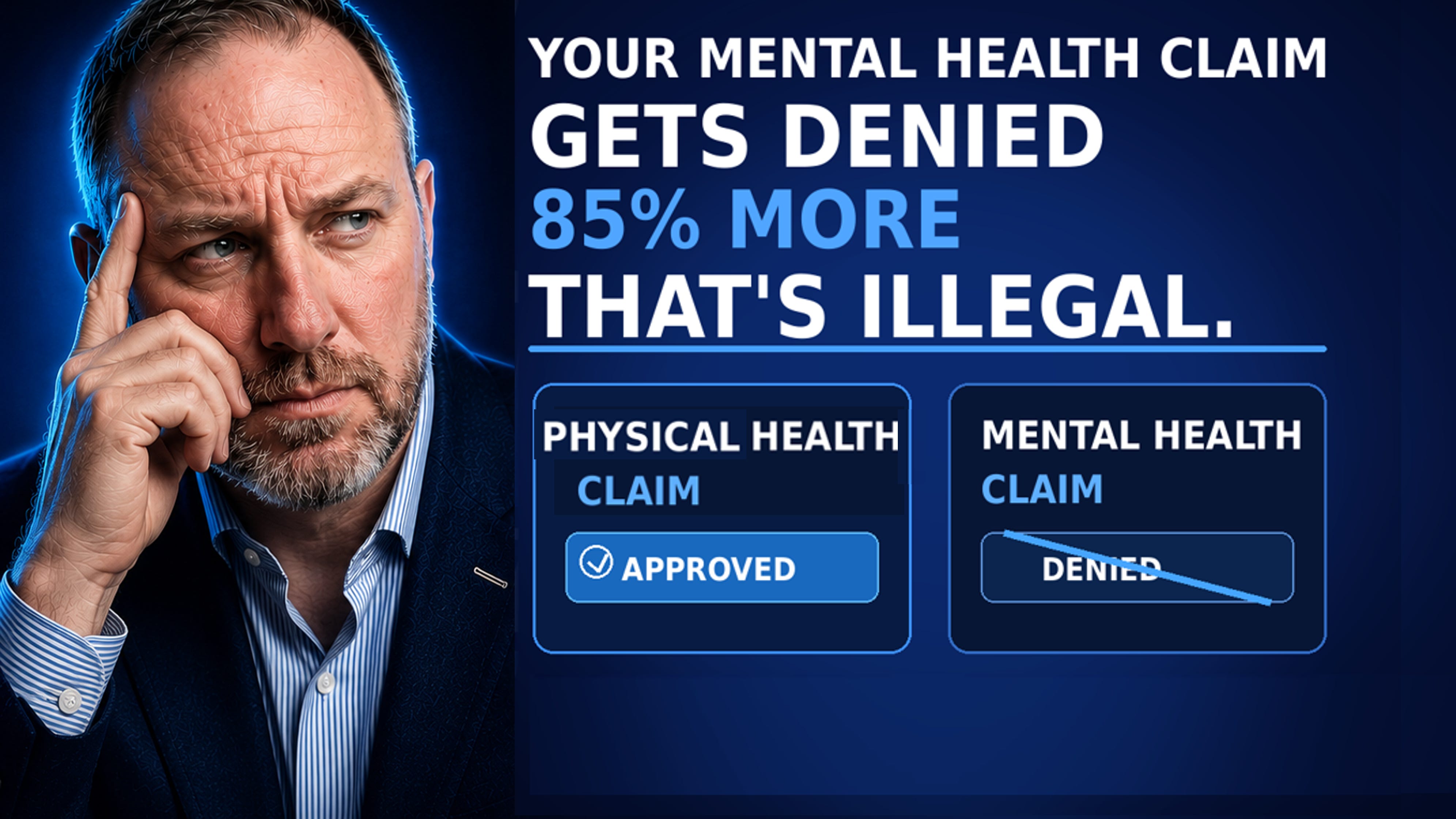
The American Psychiatric Association documented what those violations produce: behavioral health services face denial rates 85% higher than comparable medical services. Eighty-five percent higher. On claims that federal law explicitly requires to be treated equivalently.
The federal government acknowledged the ongoing failure directly. When new parity rule amendments were finalized in 2024, the government’s own language stated: “In the almost 16 years since the enactment of MHPAEA, disparities in coverage between mental health and substance use disorder benefits and medical/surgical benefits have persisted and grown.”
Persisted and grown. Not closed. Not addressed. Grown.
Here is why. Denying mental health claims saves insurance companies money, and the penalties for violations are usually much lower than the savings they can recoup. The math is straightforward. Violate the law, deny the claims, collect the savings, pay the occasional fine. Net positive. Repeat annually.
The law exists. The enforcement doesn’t. And the patients waiting for an approved authorization on a psychiatric hospitalization, or a therapist who takes their insurance, or a treatment plan that extends beyond an arbitrary session limit, are paying the price of that calculation.

Why Your Therapist Doesn’t Take Your Insurance
The parity violation at the coverage level compounds a separate structural failure at the provider level. Even if an insurer technically covers mental health services, finding a provider who accepts that insurance is a different problem entirely.
For similar mental health services, nonpsychiatric medical doctors received anywhere from 13% to 20% higher in-network reimbursement than psychiatrists. That is for the same category of service, covered under the same law, paid at a systematic discount because the service is mental rather than physical.
The downstream consequence is predictable and documented. A master’s-level therapist in New Hampshire could bill $29 per hour under Medicaid when the market rate was $45 per hour. That gap does not produce a shortage of patients willing to be seen. It produces a shortage of therapists willing to accept the reimbursement.
Approximately 47% of the U.S. population, 158 million people, live in a mental health workforce shortage area. The shortage is not primarily a training pipeline problem. It is a reimbursement problem. The system has made providing mental healthcare financially nonviable at the rates it pays, and then expresses bewilderment that patients cannot find providers.

This is the same logic I see in orthopedics, in primary care, and in every specialty where insurers have used reimbursement suppression as a demand-control mechanism. Pay less than it costs to provide the service. Providers exit the network. Access contracts. Patients get denied not by an explicit denial but by a network that does not actually exist at the density the insurance card implies.
The mental health version of this is more acute because the stakes are higher and the alternatives are fewer. A patient who cannot access an orthopedic surgeon has pain and functional limitation. A patient who cannot access a psychiatrist may have neither the insight nor the stability to navigate the insurance bureaucracy, find an out-of-network provider, or sustain the self-advocacy a broken system requires.
The Physicians Nobody Is Treating
I want to say something now that most physicians know and almost none say publicly.
According to Medscape’s 2024 physician survey of over 9,000 physicians, 49% report feeling burned out and 20% report depression. Among those burned out, 62% cited bureaucratic tasks as the primary reason, 41% cited spending too many hours at work, and 40% cited lack of respect from administrators.
Nearly half of physicians are burned out. One in five is depressed. These are not marginal findings from a small sample. This is the clinical workforce that 335 million Americans depend on for their care.
And the system has built a structure that makes it dangerous for those physicians to seek treatment.
An estimated 300 physicians die by suicide each year in the United States, nearly one per day. Physicians have one of the highest suicide rates of any profession. And yet the same licensing and credentialing infrastructure that is supposed to ensure physician fitness creates a direct disincentive to disclose mental health treatment. In most states, licensing renewal asks whether a physician has received mental health care. In most hospital credentialing processes, mental health history is a reviewable factor. The message the system sends is clear: suffer in silence, or risk your career.
The result is predictable. Only 14% of physicians who experienced mental health symptoms sought medical attention for those symptoms. The people trained to recognize and treat illness in others are, by enormous margins, not treating their own.
I have watched this pattern in colleagues I respect. The surgeon who is visibly struggling but will not see anyone because the paperwork trail is too risky. The resident who is not sleeping, not eating, not functioning, and who believes asking for help is a sign of weakness the system will use against them. The attending who self-medicates because the alternative requires documentation they cannot afford.
This is not a resilience failure. It is a structural failure with a body count.
The Two Problems Are the Same Problem
Here is what connects these two failures.
The mental health system fails patients and physicians for the same underlying reason: the financial architecture of American healthcare treats psychological illness as categorically less serious than physical illness, and has built reimbursement, coverage, and credentialing structures that encode that hierarchy into every interaction.
A surgeon with a torn rotator cuff gets it fixed. Their career is not threatened by the disclosure. A surgeon with major depression navigates a gauntlet of professional risk to access care that the law nominally guarantees but the system structurally withholds.
A patient with a broken leg gets authorization for surgery quickly. A patient with a psychiatric crisis waits weeks for an authorization that federal law says must be issued on equal terms with physical health approvals, but that gets denied at 85% higher rates anyway.
The mental health parity law was the right diagnosis. The enforcement has been, for seventeen years, essentially non-existent.
The 2024 rule amendments have teeth, theoretically. Insurers must now document that they are not applying more restrictive criteria to mental health than to physical health. Audit requirements have expanded. The burden of proof has shifted modestly toward the insurer.
I will believe the law is being enforced when the denial rate gap closes. It has not closed yet.

What I Am Asking For
For policymakers: enforce the law that already exists. The 74% violation rate in audited plans is not a compliance problem requiring new legislation. It is an enforcement problem requiring political will. The fines need to be large enough to change the math. Right now, they are not.
For hospital systems and physician employers: stop making it professionally dangerous for physicians to access mental health care. Licensing questions about mental health treatment history should not be the reason a physician in crisis chooses silence over treatment. The credentialing infrastructure needs to distinguish between untreated mental illness and treated mental illness. One is a clinical risk. The other is evidence that a physician is managing their health responsibly.
For physicians reading this: the colleague who asked for help is not the weak one in the room. The system that made asking dangerous is the problem. Not you.
The same anger I carry for patients who cannot access care they are owed, I carry for the physicians who cannot access care they need.
We built a system that demands everything from the people delivering care and provides almost nothing in return when they are the ones who are struggling.
That is not a healthcare system. That is an extraction model. And it is time to say so plainly.
ALSO… did you know… I have a podcast called Unhinged with Dr. Michael Meneghini.
You can see all current and past episodes here: https://www.buzzsprout.com/2627550